Using Your Body to Unlock Your Mind: Relaxation as the Gateway to Transformation

Two years ago, if someone had suggested I spend 20 minutes doing breathing exercises or slow-motion movements to "calm my nervous system," I would have handed them a spreadsheet showing exactly how much work I could accomplish in those 20 minutes instead. Relaxation? That was for people who didn't have quarterly targets, emergency board meetings, or blood sugar crashes at 3 AM.
I'm a CFO. I live in a world where tension is the default setting. High stakes. Tight deadlines. Constant vigilance. My body had been in some version of fight-or-flight for so long I'd forgotten what actual relaxation felt like. I thought I was relaxed when I finally collapsed into bed at night, too exhausted to think.
Turns out, exhaustion and relaxation are not the same thing. Not even close.
Here's what I discovered: You cannot reprogram your mind while your nervous system is in survival mode. It's physiologically impossible. Your brain in fight-or-flight is designed to keep you alive, not to learn, grow, or transform. It's designed to repeat familiar patterns—even destructive ones—because familiar equals safe.
If you want to access the alpha state where transformation happens, where your subconscious becomes receptive to new programming, you first have to teach your body what safety feels like. And that means learning to relax consciously.
Not collapse. Not zone out in front of Netflix. Actually relax—systematically, intentionally, using your body as the entry point.
This is Step 2 of the Thrive Framework: Harmonize Your Energy. Before you can install new neural pathways, you have to create the neurological conditions that make installation possible. And those conditions require a calm nervous system.
So let me share the methods that actually worked for me—not because I believed in them, but because I tested them and measured the results. Some of them initially sounded absurd. All of them work.
Why Your Body Is the Key to Your Mind
Let's start with the neuroscience, because that's what actually convinced me to try this stuff.
Your autonomic nervous system has two modes. The sympathetic nervous system is your accelerator—fight, flight, or freeze. It's designed for short-term survival threats. Your heart rate increases, your breathing shallows, blood flow redirects to major muscle groups, and your prefrontal cortex (the part of your brain that does complex thinking) essentially goes offline.
The parasympathetic nervous system is your brake—rest, digest, and restore. Heart rate slows, breathing deepens, blood flow returns to your organs and brain, and your prefrontal cortex comes back online. This is where learning, creativity, and neuroplasticity happen.
Most of us spend the majority of our waking hours with our foot on the accelerator. Chronic stress. Constant stimulation. Always in beta brainwave state—alert, analytical, ready for the next crisis. Even when there's no actual tiger chasing us, our nervous system can't tell the difference between a predator and an angry email.
Here's the problem: Your brain cannot enter the alpha state—where transformation and reprogramming happen—while your nervous system is in sympathetic dominance. It's like trying to update your computer's operating system while running every application simultaneously and downloading files in the background. The system is too busy managing immediate demands to install anything new.
You need to activate the parasympathetic system. You need to take your foot off the accelerator. And the most direct, reliable way to do that is through your body.
Why? Because the body-mind connection runs both ways. Your mental state affects your body (think of how anxiety creates tension), but your body also affects your mental state. When you consciously relax your muscles, slow your breathing, or move in certain ways, you send a signal to your brain: "We're safe. You can stand down."
Your brain listens. Stress hormones decrease. Brainwave patterns shift from beta toward alpha. The critical faculty—that gatekeeper that maintains your existing beliefs and filters out contradictory information—softens. Your subconscious becomes receptive.
This is why every effective transformation practice—from the Silva Method to Dr. Joe Dispenza's work to traditional meditation—starts with physical relaxation. Not because it's woo-woo. Because it's physiology.
Method 1: Breath-Based Relaxation
Your breath is the most accessible tool you have for nervous system regulation. It's also the only part of your autonomic nervous system that's under both voluntary and involuntary control. You breathe automatically, but you can also choose to breathe differently. And when you do, everything else follows.
When you're stressed, your breathing becomes shallow and rapid—short breaths high in the chest. This signals danger to your brain, which ramps up stress hormones, which makes your breathing even shallower. It's a feedback loop.
But you can reverse the loop. When you consciously slow and deepen your breathing, you activate the vagus nerve—a major pathway of the parasympathetic system. Your heart rate slows. Your blood pressure drops. Your brain gets the signal: "We're safe."
Within minutes—sometimes seconds—you shift from sympathetic to parasympathetic dominance. From beta toward alpha. From fight-or-flight to rest-and-digest.
I use two primary approaches:
Box Breathing (The Tactical Entry Point)
This was my gateway because it's absurdly simple and requires no special knowledge. Four counts in, four counts hold, four counts out, four counts hold. Repeat for five minutes.
That's it. No mysticism. No Sanskrit terms. Just a pattern your nervous system recognizes as "not in danger."
I started doing this before important meetings. Five minutes in my car, eyes closed, breathing in this pattern. The difference was immediate and measurable. My heart rate variability improved (I tracked it). My decision-making got sharper. I stopped reacting defensively to challenges and started responding strategically.
Box breathing is your nervous system's reset button. It works because it regulates the balance between oxygen and carbon dioxide in your blood, which directly affects your brain state. Simple, mechanical, effective.
Pranayama (The Deeper Practice)
After box breathing convinced me that breath work wasn't nonsense, I got curious about more sophisticated approaches. That led me to pranayama—the yogic science of breath control.
I'm not going to pretend I'm a pranayama expert or that I do this in any traditional way. What I learned is that different breathing patterns create different effects on your nervous system and brain state. Some are energizing, some are calming, some are balancing.
The technique I use most consistently is alternate nostril breathing (Nadi Shodhana). You close one nostril, inhale through the other, switch, exhale through the first, inhale through the second, switch, exhale through the first. It sounds ridiculous. It works remarkably well.
The research suggests this practice balances the left and right hemispheres of the brain, calms the nervous system, and—critically for our purposes—facilitates the shift into alpha state. After ten minutes of this practice, I can reliably move into the relaxed-yet-alert state where visualization and mental rehearsal are most effective.
But here's what matters: you don't need to become a pranayama practitioner. You just need to discover that your breath is a lever you can pull. Box breathing is enough. If you get curious, explore further. If not, that one technique will serve you for life.
Method 2: Meditation in Movement
The second discovery that changed everything for me was this: You don't have to sit still to access alpha state.
I'd tried traditional sitting meditation several times over the years. I lasted maybe three minutes before my mind started screaming at me about all the things I should be doing instead. I assumed meditation "wasn't for me." I was too Type A, too restless, too busy.
Then I discovered you can move into meditative states. Slowly. Intentionally. Using your body's motion as the focus point instead of your breath or a mantra.
Qi Gong: Moving Meditation
Qi Gong is a Chinese practice that combines slow, flowing movements with breath and mental focus. It looks like Tai Chi's gentler cousin—graceful, deliberate, almost hypnotic.
I started doing it because a colleague mentioned it helped his chronic back pain. I figured if it was good for pain management, it might have some validity. What I didn't expect was how profoundly it shifted my mental state.
The practice works because it gives your conscious mind something to do (coordinate the movements, stay balanced, breathe in rhythm) while simultaneously calming your nervous system. Your body is moving, so your restless mind doesn't revolt against stillness. But the movements are so slow and intentional that you can't stay in beta state—the analytical, problem-solving, always-planning mode.
Within about ten minutes, I reliably drop into a relaxed state. My thoughts slow down. The constant mental chatter that usually dominates my awareness fades into the background. I become aware of physical sensations I normally ignore—the weight of my body, the temperature of the air, the subtle shifts in balance.
And here's the remarkable part: this state persists after the practice. I'll do 20 minutes of Qi Gong in the morning, and over the next several hours, I notice I'm calmer, more present, and less reactive. It's like the practice creates a buffer between stimulus and response. Someone brings me a problem, and instead of immediately jumping into fix-it mode, I pause. I consider. I respond from a grounded place rather than reacting from stress.
The neuroscience makes sense. Slow, coordinated movement requires bilateral activation—both hemispheres of your brain working together. This creates coherence. The rhythmic nature of the movements, combined with breath, naturally downregulates your nervous system. And the focused attention required keeps you present rather than lost in thought.
You don't need a teacher (though it helps). There are countless free videos online. Find a simple routine, practice it daily for two weeks, and notice what shifts.
Other Movement Practices
Qi Gong works for me, but the principle applies to any slow, intentional movement practice. Tai Chi is the more well-known version. Some forms of yoga, particularly slower styles like Yin or Restorative, create similar effects. Even walking meditation—moving very slowly with full attention to each step—can induce alpha states.
The key is: slow, intentional, attention-demanding movement that occupies your conscious mind while calming your nervous system. Your body becomes the anchor that prevents your mind from spinning into thought loops.
Method 3: Body Awareness and Systematic Relaxation
Breath and movement work from the outside in—you change your physical state, which changes your mental state. But there's another approach that works from awareness: learning to consciously recognize and release tension you didn't even know you were holding.
Progressive Muscle Relaxation
This technique was developed in the 1930s by Edmund Jacobson, a physician who noticed that most people have no idea what muscular relaxation actually feels like. They think they're relaxed when they're not doing anything strenuous. But their muscles are still contracted, still holding patterns of chronic tension.
His solution was elegant: systematically tense each muscle group for a few seconds, then release it. The contrast teaches you what tension and relaxation actually feel like.
You work through your body methodically. Tense your right fist as hard as you can, hold for five seconds, and release completely. Notice the difference. Tense your right bicep, hold, release. Left fist. Left bicep. Face. Jaw. Shoulders. Abdomen. Legs. Feet.
I thought this would be boring and pointless. It wasn't. What I discovered is that I was unconsciously holding tension in my jaw, my shoulders, my stomach—all day, every day. I had completely habituated to it. It was just my normal state.
After three weeks of doing this practice for ten minutes before bed, something shifted. I started noticing the tension during the day. "Oh, I'm clenching my jaw right now. Why?" Then I could consciously release it. The chronic tension patterns that had been invisible became visible. And once you can see a pattern, you can change it.
The nervous system benefit is direct: when your muscles are relaxed, your brain interprets this as safety. Tension signals threat. Relaxation signals security. By systematically teaching your body how to release holding patterns, you give your brain permission to downshift out of constant vigilance.
Yoga Nidra: The Nuclear Option
If Progressive Muscle Relaxation is systematic, Yoga Nidra is comprehensive. It's sometimes called "yogic sleep," though you remain conscious throughout. It's a guided practice that leads you through a detailed body scan while you lie completely still, usually inducing deep alpha or even theta brainwave states.
You lie on your back, eyes closed, while a guide directs your attention systematically through every part of your body. Not tensing and releasing, just bringing awareness. "Notice your right thumb. Notice your right index finger. Notice your right middle finger." Slowly, methodically, mapping your entire physical form in your conscious awareness.
Two things happen. First, your conscious mind is occupied with following the instructions, which prevents it from spinning into thought loops about your to-do list. Second, the systematic attention to body sensations naturally induces deep parasympathetic activation. Your nervous system interprets this comprehensive body awareness as profound safety.
Research suggests that 30 minutes of Yoga Nidra provides restorative benefits equivalent to 2-4 hours of sleep. I can't verify that claim, but I can tell you this: after a Yoga Nidra session, I feel more rested and clear-headed than after a nap. And unlike a nap, I'm not groggy afterward. I'm alert but calm—the exact state you want for visualization and mental rehearsal.
The practice is particularly useful if you're someone whose mind refuses to quiet during traditional meditation. Yoga Nidra works precisely because it keeps your conscious mind engaged. You're following instructions the entire time. But the nature of those instructions—rest, release, notice, soften—naturally guides you into the alpha state where reprogramming becomes possible.
There are countless free guided sessions on YouTube or meditation apps. Find one you like, lie down somewhere comfortable, and let the guide do the work.
Method 4: Technology-Assisted Approaches
Sometimes you're too stressed, too wired, or too impatient for any of the above to work. I get it. There are days when my nervous system is so activated that trying to relax feels impossible. My breath is shallow, my muscles are locked, and my mind is racing at triple speed.
That's when I turn to technology.
Binaural Beats and Hemi-Sync
Your brain operates at different electrical frequencies. Beta (13-30 Hz) is alert, analytical thinking. Alpha (8-13 Hz) is a relaxed focus. Theta (4-8 Hz) is deep meditation and dreaming. These frequencies can be measured with EEG and correspond to distinct subjective states.
Here's the fascinating part: your brain naturally entrains to rhythmic stimuli. If you hear a repetitive beat at a certain frequency, your brainwaves will gradually synchronize to that frequency. This is called "frequency following response."
Binaural beats exploit this mechanism. You listen to two slightly different frequencies in stereo headphones—say, 200 Hz in your left ear and 208 Hz in your right ear. Your brain perceives the 8 Hz difference as a "beat" and begins to entrain to that frequency. Eight Hz is alpha. Within 10-15 minutes, your brain is operating in an alpha state.
It sounds like science fiction. The research is solid. And personally, I find it works reliably even when nothing else does.
I use Hemi-Sync audio recordings, which combine binaural beats with carefully crafted soundscapes designed to induce specific states. When I'm too wound up to meditate, too restless for Qi Gong, too activated for breath work, I put on headphones, lie down, and let the technology do the work.
Twenty minutes later, my nervous system has downregulated. My thoughts have slowed. I'm in the alpha state where visualization and mental rehearsal are most effective.
This isn't cheating. It's leveraging a tool. If your goal is transformation and you have a technology that reliably creates the neurological conditions for transformation, use it. Be pragmatic.
You can find binaural beat tracks designed for specific purposes: relaxation, focus, deep meditation, and creativity. Experiment. Find what works for your nervous system.
The Practice: How to Actually Use These Methods
Here's what I'd suggest based on what worked for me.
Start with breath. Box breathing is simple, requires no equipment, takes five minutes, and works immediately. Do it daily for one week. Notice how you feel during and after. Notice if anything shifts in your typical stress response patterns.
If that resonates, explore pranayama. If it doesn't, that's fine—box breathing is enough.
Add movement. If you're restless or find sitting meditation difficult, try Qi Gong or another slow movement practice. Find a 10-20 minute routine on YouTube. Practice it daily for two weeks. Notice if you drop into a different mental state. Notice if that state persists after the practice.
Experiment with systematic relaxation. Try Progressive Muscle Relaxation for a week before bed. Try Yoga Nidra when you're exhausted, but your mind won't stop. See what happens.
Use technology when you need it. On days when you're too activated for organic methods to work, use binaural beats to force your brain into the state you want.
The goal isn't to master all of these. The goal is to find which doorways into the alpha state work reliably for your nervous system. Then use them consistently.
Because here's what matters: You cannot reprogram your mind while your body is signaling danger. The visualization, the mental rehearsal, the identity transformation work—none of it sticks if your nervous system is in fight-or-flight.
These practices aren't preparation for the real work. They are the foundation that makes the real work possible. When your nervous system is calm, when your brainwaves shift from beta to alpha, when your subconscious becomes receptive—that's when you can install new patterns. That's when transformation happens.
It took me 40 years to learn this. My body had been in chronic stress for so long that I thought tension was normal. I thought relaxation was a weakness or a waste of time. I was wrong on both counts.
Teaching your body what safety feels like isn't self-indulgence. It's the prerequisite for changing your mind. And changing your mind is the prerequisite for changing your life.
Ready to explore the next step? Once your nervous system is calm and you've accessed the alpha state, you can begin the real work: mentally rehearsing your desired reality and installing new neural pathways. That's where transformation accelerates. But it starts here, with your body teaching your brain that it's safe to change.
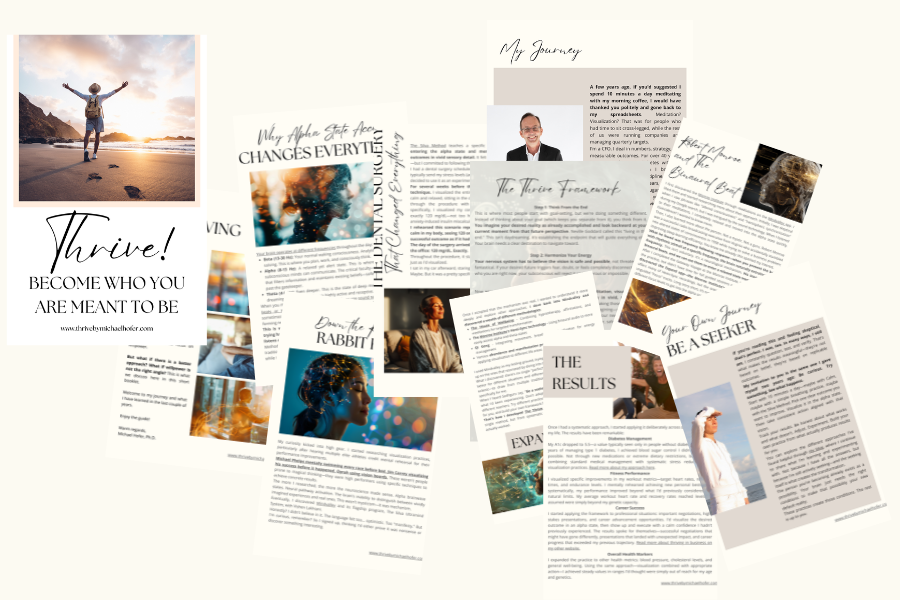
A practical guide to thriving—without relying on willpower
What if lasting change wasn’t about trying harder, but about working with how your brain actually functions?
In this free booklet, I share how a data-driven CFO and lifelong skeptic discovered a simple, science-backed approach to transformation—by accessing alpha brain states, reducing stress, and reprogramming subconscious patterns that quietly shape our behavior.
No mysticism. Just a clear framework you can test yourself.
Download the guide. Run your own experiment.
If it adds value, stay curious and continue the journey through my newsletter.
If not, no strings attached.