Becoming Nothing to Create Everything: Dr. Joe Dispenza's Approach
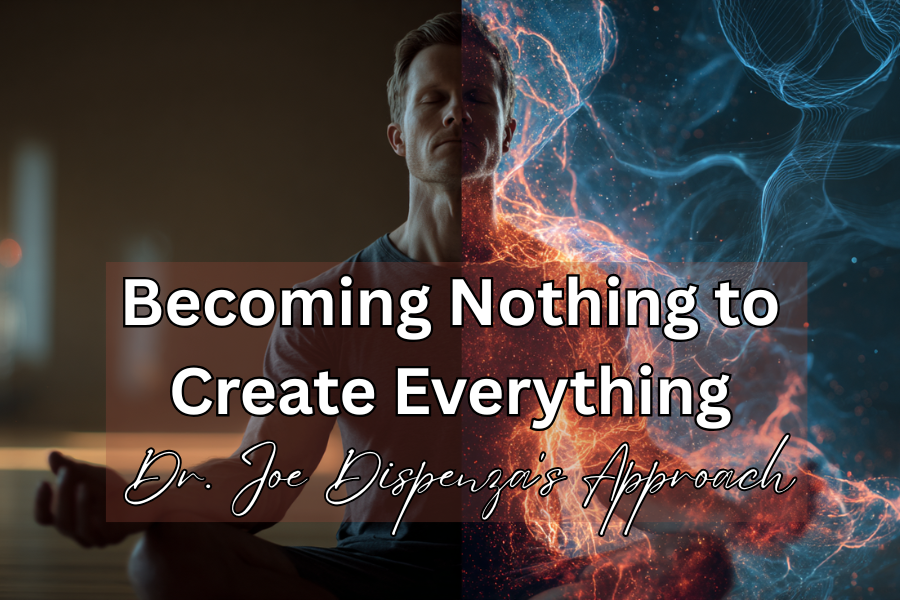
The problem isn't that you don't know what you want. The problem is that you're still too attached to who you've been.
When I first heard Dr. Joe Dispenza talk about "becoming nothing" in meditation, my executive brain immediately translated it to "spending time doing nothing." I'm a senior leader. I solve problems. I create strategies. I execute. The idea of sitting still and intentionally dissolving my sense of self sounded like the opposite of productivity.
But here's what I didn't understand then: You cannot create a genuinely new future while holding onto your old identity. Your past self—with all its patterns, beliefs, and limitations—will keep recreating variations of your past. To access truly new possibilities, you first have to let go of who you've been.
This isn't philosophy. It's neuroscience. And once you understand the mechanism, it stops sounding mystical and starts sounding like the most efficient path to transformation.
Who Is Dr. Joe Dispenza?
Dr. Joe Dispenza is a neuroscientist, researcher, and author who has spent decades studying the intersection of neuroscience, epigenetics, and quantum physics to understand how people can create measurable change in their lives through thought alone.
His credentials are impressive: he holds a Doctor of Chiropractic degree, has postgraduate training in neurology and neuroscience, and has published multiple New York Times bestsellers, including Breaking the Habit of Being Yourself, You Are The Placebo, and Becoming Supernatural.
When I encountered Dispenza's work, I did what any skeptical executive would do: I looked for the data. That's what led me to his Progressive Online Course: A Foundational Program for Personal Transformation With Guided Meditations. What immediately struck me wasn't the meditation practice itself—it was how thoroughly he grounds every technique in neuroscience.
Throughout the course, Dispenza doesn't just tell you to meditate; he explains exactly what's happening in your brain when you do. He shows you the brain scans. He walks through the research on neuroplasticity. He explains the measurable changes in brain wave patterns, stress hormones, and gene expression that occur during these practices. For someone like me who needs to understand the mechanism before investing time in a practice, this was essential.
What makes Dispenza's work particularly compelling is that he doesn't just theorize—he measures. His research team has documented thousands of cases of people creating significant health improvements, life changes, and even what appear to be spontaneous remissions of serious conditions through his meditation protocols. They use brain scans, blood tests, and other biometric data to track what's actually happening in the body during these practices.
His core premise is simple but radical: Your personality creates your personal reality. If you want a different reality, you need a different personality. And to build a different personality, you first need to dismantle the old one.
The Problem With Your Current Identity
Here's the issue most people don't recognize: Your identity isn't just who you think you are. It's a massive neural network of interconnected memories, beliefs, emotional patterns, and automatic behaviors.
Every time you think "I'm not a morning person," or "I'm not good with money," or "I always struggle with relationships," you're not describing some fixed truth about yourself. You're activating and strengthening a specific neural pathway. You're rehearsing being that person. You're programming your subconscious to keep creating evidence that confirms that identity.
Your personality—your habitual way of thinking, feeling, and acting—is literally hardwired into your brain through years of repetition. And here's the problem: Your personality is designed to keep creating more of your past.
Think about it: If you wake up and think the same thoughts as yesterday, those thoughts trigger the same emotional responses. Those emotions drive the same behaviors. Those behaviors create the same experiences. Those experiences reinforce the same thoughts. You're in a closed loop, running the same program over and over.
Dispenza calls this "living in the past." You're not actually experiencing the present moment—you're experiencing a replay of your memorized emotions and predictable patterns.
And as long as you remain that person—with that personality, those beliefs, those patterns—you will keep creating variations of the same reality. You can't think yourself into a new life while remaining your old self. The operating system is incompatible with the desired output.
The Neuroscience of "Becoming Nothing"
This is where the practice of "becoming nothing" becomes not mystical, but mechanically necessary.
When Dispenza guides people to "become no one, no body, no thing, in no time, in no place," he's not asking them to have an out-of-body experience or achieve enlightenment. He's asking them to do something very specific: Temporarily disconnect from the neural networks that constitute their current identity.
Here's what that means neurologically:
Your sense of self lives in your brain as patterns of neural activation. When you think about who you are—your name, your job, your relationships, your problems, your body—specific neural networks light up. These networks are heavily myelinated from years of use, which means they fire quickly and automatically.
When you practice "becoming nothing," you're intentionally not activating those networks. You're not thinking about yourself. You're not focused on your body. You're not rehearsing your problems. You're not identifying with your memories. You're not running the familiar program.
This creates what neuroscientists call "neural pruning." When you stop activating certain pathways, they begin to weaken. The myelin degrades. The connections become less automatic. The old program starts to lose its grip.
But more importantly, you create space for something new.
Think of it like clearing a cluttered room. You can't rearrange the furniture while it's full of old stuff. You first have to remove what's there. Only then can you see the empty space and imagine new possibilities.
Your identity is the same way. As long as you're constantly activating and reinforcing your existing self-concept, you can't access genuinely novel options. Your brain is too busy running the familiar patterns.
But when you become "nothing"—when you release your attachment to being that person with that history and those limitations—you create neuroplastic space. Your brain shifts into a state where new patterns can form. New connections can emerge. New possibilities become visible.
How This Connects to The Thrive Framework
If you've read my framework, you'll see that "becoming nothing" maps directly to Step 2: Harmonize Your Energy.
Remember, your nervous system has to believe your vision is safe and achievable. But if your vision requires you to be a fundamentally different person—more confident, healthier, wealthier, more creative—your current identity will fight it. Your subconscious will see that new version as threatening to the established order.
This is why positive affirmations often fail. You're trying to install "I am confident" while the existing program screams "No, you're not—remember all those times you weren't?" The new belief gets rejected because it conflicts with the entrenched identity.
"Becoming nothing" solves this problem elegantly: Instead of fighting to install a new program over the old one, you temporarily shut down the old program entirely.
It's like rebooting your computer in safe mode. You're not loading all the usual startup programs. You're operating from a clean baseline. And from that baseline, you can install new patterns without resistance from the old ones.
Here's the sequence Dispenza teaches, which aligns perfectly with the Thrive Framework:
First, you become nothing (Step 2: Harmonize Your Energy by releasing the old identity)
Then, from that state of pure potential—when you're not bound by your past self—you can clearly envision who you want to become and what you want to create (Step 1: Think From the End, Step 3: Rehearse the Vision).
The difference is dramatic. When you try to visualize your desired future while still identified as your current self, it feels like a fantasy. "That's not me." "I could never do that." The old identity rejects it.
But when you first become nothing—when you release the grip of the known self—and then imagine your future, something shifts. The new vision isn't battling against an entrenched identity. It's emerging into open space. It feels possible because you're not carrying the weight of your past.
The Practice: A Simple Version
You don't need to master Dispenza's full week-long retreats to access this mechanism. Here's a simplified version you can experiment with:
1. Get into alpha state (10-15 minutes of meditation, deep breathing, or simply sitting quietly with your eyes closed until you feel deeply relaxed).
2. Release your body: Stop focusing on physical sensations. Let your awareness of your body dissolve. You're not ignoring pain or discomfort—you're simply not identifying with the body as "me."
3. Release your environment: Stop tracking where you are. Let go of awareness of the room, the sounds, the time of day. You're not in a place. You're in no place.
4. Release your identity: Stop thinking about who you are. Not your name, your roles, your problems, your past. Let go of the story of "me." You're not that person for these few minutes. You're no one.
5. Release time: Stop tracking past and future. You're not thinking about what happened or what needs to happen. You're in no time—just this eternal present moment.
What you're left with is pure awareness. Not you being aware. Just awareness itself. Consciousness without content. Presence without personality.
6. From this cleared space, create your future as already real: This is where the power of starting from "nothing" becomes obvious. You're not trying to convince your old identity that something new is possible—there's no old identity present to resist. From this space of pure potential, vividly imagine your desired reality as already accomplished. See it. Feel it. Experience it in rich, multisensory detail. You're not hoping for it or working toward it—you're already living it. This is similar to the Silva Method, but far more powerful because there's no resistance from your existing self-concept. The new reality can install itself cleanly into the neuroplastic space you've created. Spend several minutes fully inhabiting this future self, letting the neural pathways form without interference.
7. Slowly return: When you're ready, gently bring your awareness back to your body, your environment, the present moment. But notice—you're not quite the same person you were when you started this practice. Something has shifted.
This is the state from which genuine creation happens. Not the you-with-all-your-limitations creating more of your past. But consciousness itself is installing a new program into receptive neural circuitry.
Why Starting From "Nothing" Makes Visualization More Powerful
Here's what makes Dispenza's approach different from traditional visualization techniques:
When most people visualize their goals, they do so from their current identity. The skeptical voice is always there: "That's not realistic for me." "I've tried this before and failed." "That's not who I am." The old neural networks are active, constantly comparing the vision to past evidence and finding it lacking.
It's like trying to record a new song while the old one is still playing. The interference creates noise, resistance, and ultimately, failure.
But when you first become nothing—when you've temporarily dissolved the old identity—there's no voice saying "that's not me." There's no past to contradict the vision. There's no identity to protect.
You're installing the new program into a clean system.
This is why people report that Dispenza's meditations feel different. The visualizations aren't fantasy—they feel real, because there's nothing inside contradicting them. Your nervous system accepts them as possible because your old limitations aren't present to object.
It's the difference between trying to convince a skeptic (your old self) versus speaking to someone with no preconceptions (pure consciousness). The second conversation goes much more smoothly.
The Paradox That Makes This Work
Here's the beautiful paradox: You have to let go of control to gain access to true creative power.
Your old identity feels safe because it's familiar. It's predictable. It's known. But it's also limited to what it's already experienced. It can only recombine variations of your past.
When you become nothing—when you surrender the tight grip on being that specific person with that specific history—you don't lose yourself. You gain access to a much larger field of potential.
As Dispenza puts it: "The quantum field responds not to what we want, but to who we are being." As long as you're being your old self, the field keeps delivering your old results. But when you step into the unknown—into the space of "no one, no body, no thing"—you become available to genuinely new possibilities.
This is why Jim Carrey's visualization worked. Why Phelps' mental rehearsals transformed his performance. Why Oprah's vision board manifested. They weren't just imagining a better future. They were temporarily releasing their attachment to their current identity and allowing a new version to install.
Your Five-Minute Experiment
I know this sounds esoteric. Two years ago, I would have stopped reading by now. Probably even earlier. But I'd invite you to test it empirically:
Tomorrow morning, before you check your phone or start thinking about your day, spend just five minutes becoming nothing, then creating from that space:
Sit comfortably, close your eyes
Take slow, deep breaths until you feel calm
Let your awareness of your body fade
Let your thoughts about who you are fade
Just be present, without identifying as anyone or anything
Feel deeply the freedom that comes from it
From that empty space, vividly imagine your desired reality as already accomplished
Stay in that vision for several minutes, letting it feel completely real
Then gently return to the present
Notice what's different. Maybe nothing. Maybe everything. But you can't know until you try.
Because the future you want to create isn't going to emerge from more thinking, more planning, or more effort by your current self. It's going to emerge from the space you create by temporarily letting go of that self.
The person you're becoming already exists as potential. But that potential can't install itself until you make room by releasing who you've been.
Becoming nothing isn't giving up. It's clearing the way for everything.
Ready to explore more? Check out the full framework to see how "becoming nothing" fits into the complete transformation process, or read about other techniques for accessing the alpha state where this work happens.