Your Brain's Five Gears: Understanding How They Can Help in Your Transformation

Two years ago, if you'd told me I needed to understand brainwave frequencies to be effective at my job, I would have assumed you were selling me on some neurofeedback headband that costs more than my car.
I'm a CFO. I deal in EBITDA, not EEG. The idea that understanding the electrical frequencies of my brain would have any practical application to leading M&A deals or coaching executives? That sounded like the kind of thing you'd learn at a meditation retreat, not in a boardroom.
But then I started experimenting with these practices—meditation, visualization, the Silva Method—and kept noticing the same pattern: they all worked, and they all worked by doing the same thing. Getting you to shift your brain into a specific electrical frequency where transformation becomes possible.
That's when I stopped dismissing it and started getting curious. Turns out your brain isn't operating at one fixed frequency. It runs on five distinct patterns—call them gears—and most people spend their entire lives stuck in third gear, wondering why they can't access the mental states they need for real transformation.
Let me show you what happens when you learn to shift deliberately.
The Problem with Staying in One Gear
Imagine driving cross-country but never shifting out of third gear. You could technically get there, but you'd burn out your engine trying to climb mountains and waste fuel cruising downhill. That's most people's relationship with their consciousness—one speed for every situation.
Your brain has five gears for a reason. Each one serves a specific function. Master them, and you unlock capabilities that seem almost unfair. Ignore them, and you're constantly fighting yourself.
So let's map the transmission.
Delta (0.5-4 Hz): First Gear—Deep Restoration
This is your brain in its slowest state, the frequency of dreamless sleep and deep healing. Delta is where your body repairs tissue, consolidates memories, and runs the biological equivalent of overnight system maintenance.
You're not conscious in delta. You're offline. And that's exactly the point.
Transformation value: You can't access delta deliberately during waking hours (and you wouldn't want to—you'd literally be unconscious). But understanding delta helps you respect sleep as the foundation of all other mental states. Poor sleep keeps you stuck in higher, more stressful frequencies even when you're trying to meditate or visualize.
Think of it this way: if you're trying to reprogram your operating system but you never let the computer fully shut down and install updates, those changes never take hold. Delta is your nightly system update.
Bottom line: Delta is first gear. You need it for the long haul, but you're not driving in it.
Theta (4-8 Hz): Second Gear—The Creative Breakthrough Zone
Theta is where things get interesting. This is the frequency of deep meditation, REM dreaming, and that twilight state right before you fall asleep. Your conscious mind is barely present, but your subconscious is wide awake and making connections your logical brain would never permit.
Theta is where breakthrough insights appear. Where solutions to problems you've been wrestling with suddenly become obvious. Where creative ideas arrive fully formed—not because you forced them, but because your analytical defenses dropped long enough for pattern recognition to work without interference.
Transformation value: Theta is too slow for deliberate programming (you're not conscious enough to direct it), but it's valuable for accessing intuition and dissolving rigid mental patterns. This is where extended meditation sessions take you, where insights spontaneously emerge, where your sense of being stuck in one identity loosens.
Practical use: You drift through theta naturally every night. But you can also access it through extended meditation (20+ minutes), breathwork, or even just lying still with eyes closed after waking. The trick is staying aware while your brain slows down—which takes practice.
Bottom line: Theta is where transformation happens to you. Alpha is where you make it happen.
Alpha (8-13 Hz): Third Gear—The Programmable Sweet Spot
Here it is. The frequency I talked about in my Silva Method post. Alpha is where your brain is relaxed but alert, calm but focused. You're conscious enough to direct your thoughts, but your critical factor—that inner skeptic—has stepped aside.
This is the state you're in when you're absorbed in something enjoyable but not stressful. Reading a good book. Walking in nature. That feeling of being present but not tense. Athletes call it "the zone" when it happens during competition.
Why alpha matters for transformation: In alpha, your subconscious accepts new programming without resistance. Affirmations that bounce off in beta (normal waking state) sink right in. Visualization becomes installation, not imagination.
This is what Jim Carrey accessed when he drove up to Mulholland Drive every night—sitting in his car, relaxing, visualizing himself as already successful. He wasn't daydreaming. He was downshifting into alpha to install new neural programming.
Transformation value: Alpha is where you do the work. This is where you rehearse your future self, where you program new beliefs, where you align your nervous system with your desired reality. You're conscious enough to be intentional but relaxed enough to bypass resistance.
Practical use: You can drop into alpha in minutes with simple techniques: slow breathing, countdown methods, progressive relaxation, even just closing your eyes and letting your mind wander. Morning and evening, when your brain naturally dips toward alpha, are prime time.
Bottom line: If you're serious about transformation, alpha is your operating frequency. Learn to shift into it at will.
Beta (13-30 Hz): Fourth Gear—Active Engagement
Beta is your default waking state—the frequency of thinking, analyzing, problem-solving, and getting things done. Your conscious mind is fully online, your critical factor is alert, and you're engaged with the external world.
Most people live here. All day. Every day. Which is fine for productivity but terrible for reprogramming.
Transformation value: Beta is where you execute on the programming you installed in alpha. You can't transform in beta—your defenses are too strong, your mind too skeptical—but you need beta to take action on your insights.
Here's the key: beta is where you practice your new identity through behavior. Alpha is where you install it. Beta is where you live it.
This is what Michael Phelps did brilliantly: He mentally rehearsed races in alpha state every night (installing the programming), then swam physically in beta state during training (executing the programming). The combination—not either alone—created Olympic dominance.
The trap: Spending all your time in high beta (18-30 Hz) creates chronic stress. Your brain never downshifts. You're constantly in fight-or-flight, which makes transformation nearly impossible because you're always defending the status quo.
Bottom line: Beta is essential for action, but you can't transform here. You have to downshift first.
Gamma (30-100 Hz): Fifth Gear—Peak Performance
Gamma is your brain's highest frequency, associated with peak performance, intense focus, and moments of insight where everything clicks. Advanced meditators show strong gamma activity. So do people experiencing flow states.
Gamma is when all parts of your brain synchronize. Different regions that normally operate independently suddenly coordinate perfectly. It's not a frequency you force—it emerges when you're operating at your best.
Transformation value: Gamma represents integration. When your new identity (programmed in alpha) becomes so natural that you execute it flawlessly (in beta), those moments of peak performance might flash into gamma. It's not a state you aim for—it's what happens when everything else aligns.
Think of it as the difference between consciously thinking about every movement when learning to drive versus the effortless coordination of an experienced driver navigating traffic. Gamma is the brain signature of mastery.
Bottom line: Gamma is the reward for mastering the other gears. You can't force it, but you can create conditions for it by working systematically through the other states.
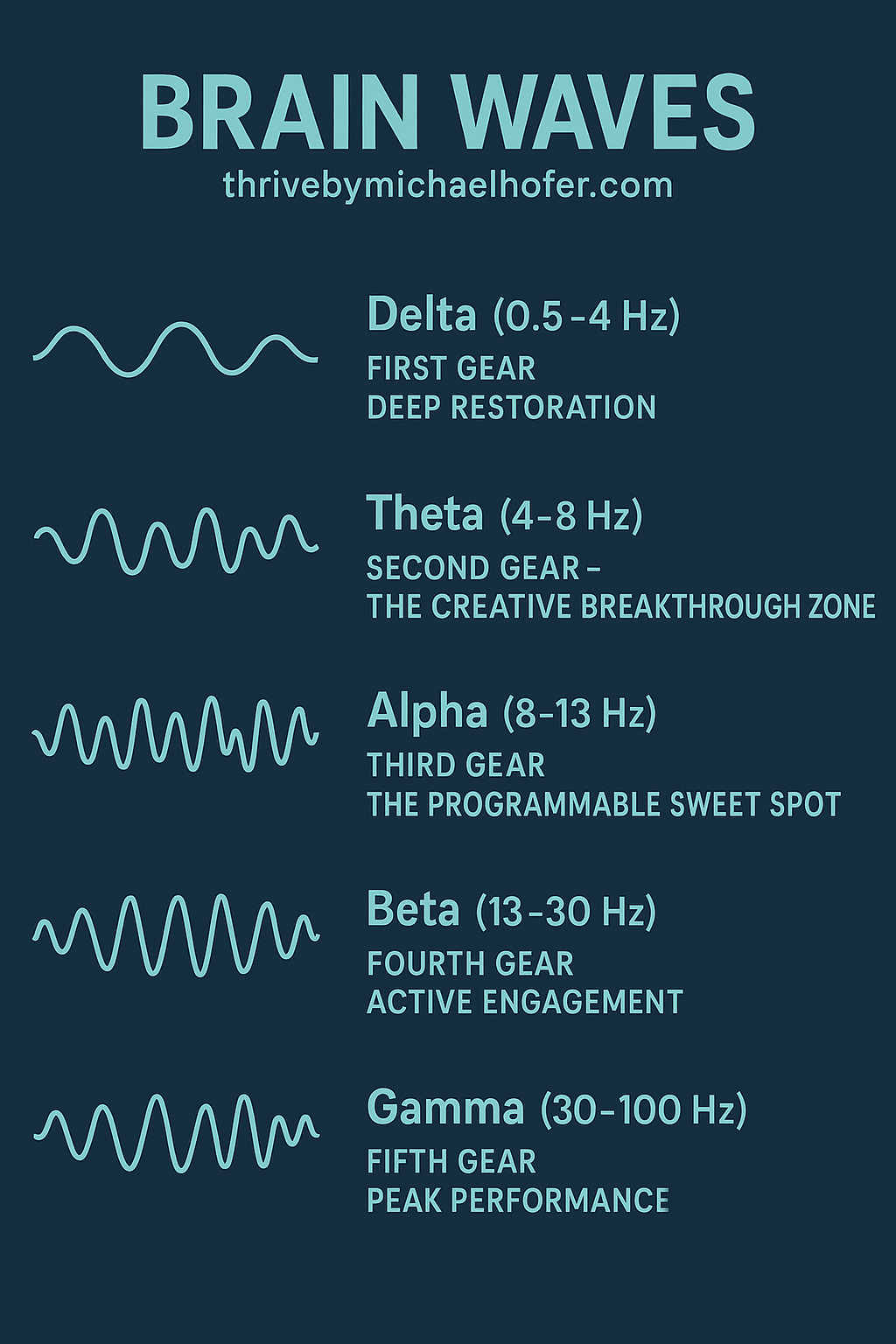
The Transformation Map: Which Gear When?
Now here's where it gets practical. Different transformation tasks require different gears:
Installing new beliefs and programs? Alpha. (Silva Method, visualization, self-hypnosis)
Dissolving old patterns and accessing intuition? Theta. (Deep meditation, breathwork, extended practice)
Taking action on your vision? Beta. (Planning, executing, building habits)
Peak performance and flow? Gamma. (Emerges naturally when you're fully aligned)
Biological healing and memory consolidation? Delta. (Sleep, deep rest)
Most people try to transform entirely in beta—thinking their way into a new reality. It doesn't work because beta is the gear that defends your current operating system. It's not designed for upgrades. It's designed for execution.
Real transformation requires downshifting to alpha, programming the change, then upshifting back to beta to execute it.
This is why willpower alone fails. You're trying to override your programming in beta (high resistance) instead of actually changing the programming in alpha (low resistance).
How This Maps to the Thrive Framework
Remember my five-step framework? Here's how brainwave states amplify each step:
1. Think From the End — Access alpha (or even theta) to visualize your desired outcome without your inner skeptic immediately shooting it down.
2. Harmonize Your Energy — Drop from beta into alpha to create coherence between conscious intention and subconscious acceptance. Your nervous system can't harmonize while you're in stressed-out high beta.
3. Rehearse the Vision — Stay in alpha while mentally living your future reality, allowing your nervous system to accept it as real through repeated exposure.
4. Integrate the Identity — Alternate between alpha (programming sessions) and beta (daily practice) until the new identity becomes automatic. Installation plus execution.
5. Embody the Reality — Eventually, your new baseline shifts. You spend more time in optimal states (balanced beta, easy access to alpha, occasional gamma). The transformation becomes your new normal operating frequency.
Your Practical Gear-Shifting Practice
You don't need fancy equipment or years of training. You just need to practice shifting gears deliberately:
Morning (Downshift to alpha for 10-15 minutes):
Sit quietly, eyes closed
Breathe slowly and deeply
Count down from 10 to 1, feeling yourself relax with each number
Visualize your day going beautifully from your thriving self's perspective
Count back up, bringing that programmed state with you
Throughout the day (Maintain optimal beta):
Take brief breaks to breathe and reset when you notice stress climbing into high beta
Avoid getting stuck in stressed-out high beta for hours at a time
Use movement, nature, or simple mindfulness to regulate your state
Evening (Downshift before sleep):
Review your day without judgment
Drop into alpha again
Program tomorrow while you're receptive
Let yourself drift naturally through alpha into theta into delta
The goal isn't to live in alpha. It's to shift gears as needed—alpha for programming, beta for action, theta for insight, delta for restoration.
The Bottom Line
Your brain is a five-speed transmission, not a fixed-gear bicycle. Most transformation methods teach the same fundamental skill: intentional downshifting into receptive states where change becomes possible.
Silva taught you to count down to alpha. Dispenza taught you to breathe into coherence. Traditional meditation teaches you to observe thoughts until they slow down. Different techniques, same mechanism—all teaching you to shift out of defensive beta and into programmable alpha.
Neuroscience confirmed with EEG machines what contemplative traditions discovered empirically over thousands of years: Transformation doesn't happen at the frequency where you're defending yourself. It happens at the frequency where you're receptive.
Your transformation isn't about luck or perfect timing. It's about learning to operate your brain at the right frequency for the task at hand.
Time to learn to shift gears.
Want to go deeper? Check out the complete framework, the Silva Method guide, or see what high performers like Carrey and Phelps actually did to access these states.