You Don't Need a Better To-Do List. You Need a New Identity.

Here's a pattern I've seen dozens of times in high-performing people, including myself.
You decide to make a change. You build the system. The morning routine, the habit tracker, the weekly review. You read the right books, follow the right people, and know exactly what you should be doing. And for a while, maybe it even works.
Then life gets busy. The system frays. You fall off. And somewhere in the back of your mind, a familiar voice shows up: Why can't I just stick to this?
Most people answer that question by building a better system. More accountability. A stricter schedule. A smarter to-do list.
I want to suggest the problem isn't the system. It's that you're asking behavior change to precede identity change — and that's the wrong order.
The To-Do List Problem
A to-do list tells you what to do. It sits outside you, waiting to be consulted, checked off, forgotten.
An identity tells you who you are. And once you know who you are, most of the decisions make themselves.
Think about it this way. Someone who identifies as a runner doesn't debate whether to go running. The question isn't should I run today? — it's just when am I running? The action is downstream of the identity. It's not a discipline. It's an expression.
Contrast that with someone who is trying to become a runner. Every run is a negotiation. Every skipped run is a small failure. The behavior is effortful because it doesn't yet belong to who they believe themselves to be.
This isn't a motivational observation. It's neuroscience.
What's Actually Happening in Your Brain
Your brain doesn't distinguish reliably between a vividly imagined experience and a real one. Neuroimaging studies have confirmed this repeatedly. Musicians who mentally rehearse their pieces improve almost as much as those who physically practice. Surgeons who visualize procedures perform better in the operating room. Athletes who mentally rehearse build measurable muscle memory.
When you consistently activate a neural pathway — whether through physical action or vivid mental rehearsal — you strengthen it. With enough repetition, the brain wraps those connections in myelin, an insulating sheath that makes the signal travel up to 100 times faster. A dirt path becomes a superhighway.
This is how concert pianists play impossibly complex pieces without consciously thinking through each note. The behavior has been rehearsed so many times that it's become automatic. It's been installed.
Here's the implication for identity: your sense of who you are isn't fixed. It's encoded. It's a network of beliefs, memories, and patterns that your brain has built from repeated experience. And the brain continuously revises that network based on new input — including deliberate mental rehearsal.
Which means you can construct a new identity on purpose. Not through willpower. Through repetition of the right kind.
The THRIVE Framework: Identity First
The Thrive approach I write about on this site is built on exactly this principle. The five steps — Think From the End, Harmonize Your Energy, Rehearse the Vision, Integrate the Identity, Embody the Reality — aren't a self-help checklist. They're a sequence that moves you from conscious intention to subconscious installation to automatic embodiment.
Let me show you how identity lives at the heart of each step.
Think From the End
Most goal-setting keeps you separate from the goal. You think about what you want, which implicitly confirms you don't yet have it. The Thrive approach does something different: you think from the achieved state. You inhabit the reality as if it's already true and look backward from there.
This matters because your brain navigates toward a destination, not away from a problem. When you define the endpoint from the inside — as someone who already is that version of yourself — you give your nervous system something concrete to organize around.
Harmonize Your Energy
Your subconscious isn't just a passive receiver. It's a gatekeeper. If your desired future feels threatening, implausible, or fundamentally inconsistent with who you believe yourself to be, your nervous system will reject it as a threat.
This step is about reducing that resistance through breathwork, meditation, and awareness practices that bring your emotional and energetic state into coherence with the vision. You're not just calming down. You're making the new identity feel safe.
Rehearse the Vision
This is where the installation happens. In the alpha state — the relaxed, receptive brainwave state accessible through meditation and specific visualization protocols — you rehearse your desired reality in vivid, multisensory detail. You don't watch yourself from the outside. You are yourself, in that life, making those choices, feeling what it feels like.
Each rehearsal strengthens the neural pathways associated with that version of you. You're building the infrastructure for the new identity before you've lived it. This is exactly what Michael Phelps did every night before competition — mentally swimming each race in perfect detail. By race day, the outcome felt familiar. The neural pathways had already been formed.
The alpha state is what makes this more than daydreaming. Regular daydreaming happens in beta — your analytical, critical waking state. The alpha state reduces that critical filter and opens the subconscious to reprogramming. The rehearsal lands differently.
Integrate the Identity
Rehearsal in the alpha state creates the blueprint. Integration is how it becomes real.
This step is about making small, consistent choices in your daily life that align with who you've been rehearsing being. Not a heroic effort. Just the question, asked as often as possible: What would the version of me who already has this do right now?
Initially, this feels slightly odd — you're acting as if before you fully feel as if. But that's the point. Your brain updates its model of who you are based on your actions. Small, consistent, aligned choices accumulate into identity-level change. You're giving your subconscious evidence to work with.
This is where Tony Robbins' emphasis on massive aligned action connects with the framework. The alpha-state programming gives you the destination and installs the autopilot. But you still have to press the accelerator.
Embody the Reality
This is what happens when the previous steps have done their work. You stop trying to be the new version of yourself — you simply are. The thoughts, feelings, and behaviors that once required effort become automatic.
At this stage, something else shifts: your Reticular Activating System — the brain's filter for what's important — starts highlighting opportunities and information that align with your new identity. You notice things you would have walked past before. The world appears to change, because your brain is filtering reality through a different lens.
The opportunities were always there. You just weren't wired to see them.
Why This Changes Everything
Here's what this means practically.
If you try to change your behavior without first changing your identity, every action is a fight. You're asking the old version of yourself to consistently act like someone else. That's exhausting, and it eventually fails — because behavior tends to snap back to identity.
But if you do the identity work first — if you use the Thrive framework to install the new operating system at the subconscious level — the behaviors stop being a list of things you have to force. They become things you do because they're consistent with who you are.
It's not discipline. It's alignment.
The morning practice isn't something you do despite not wanting to. It's what the person you've become does in the morning. The healthy choice isn't a restriction. It's what someone who values their energy naturally chooses. The difficult conversation isn't something to dread and postpone. It's what a person with your values handles directly.
The to-do list shrinks. Or it disappears entirely — because most of it just happens.
A Practical Starting Point
If this is new territory, here's where I'd start.
Pick one domain — health, relationships, your professional life — and ask: Who is the version of me who has already achieved what I want here? Describe that person. Not their goals. Their identity. How they think. How they carry themselves. What they do automatically that you currently do effortfully.
Then spend ten minutes in the morning, before your beta-state analytical brain fully activates, inhabiting that version of you. Close your eyes. Slow your breathing. Feel into the sensory reality of being that person. Don't plan how to get there. Just be there.
Do that consistently for thirty days and observe what changes — not just in your outcomes, but in what starts to feel natural and what starts to feel inconsistent with who you are.
That shift in what feels natural? That's the beginning of an identity change.
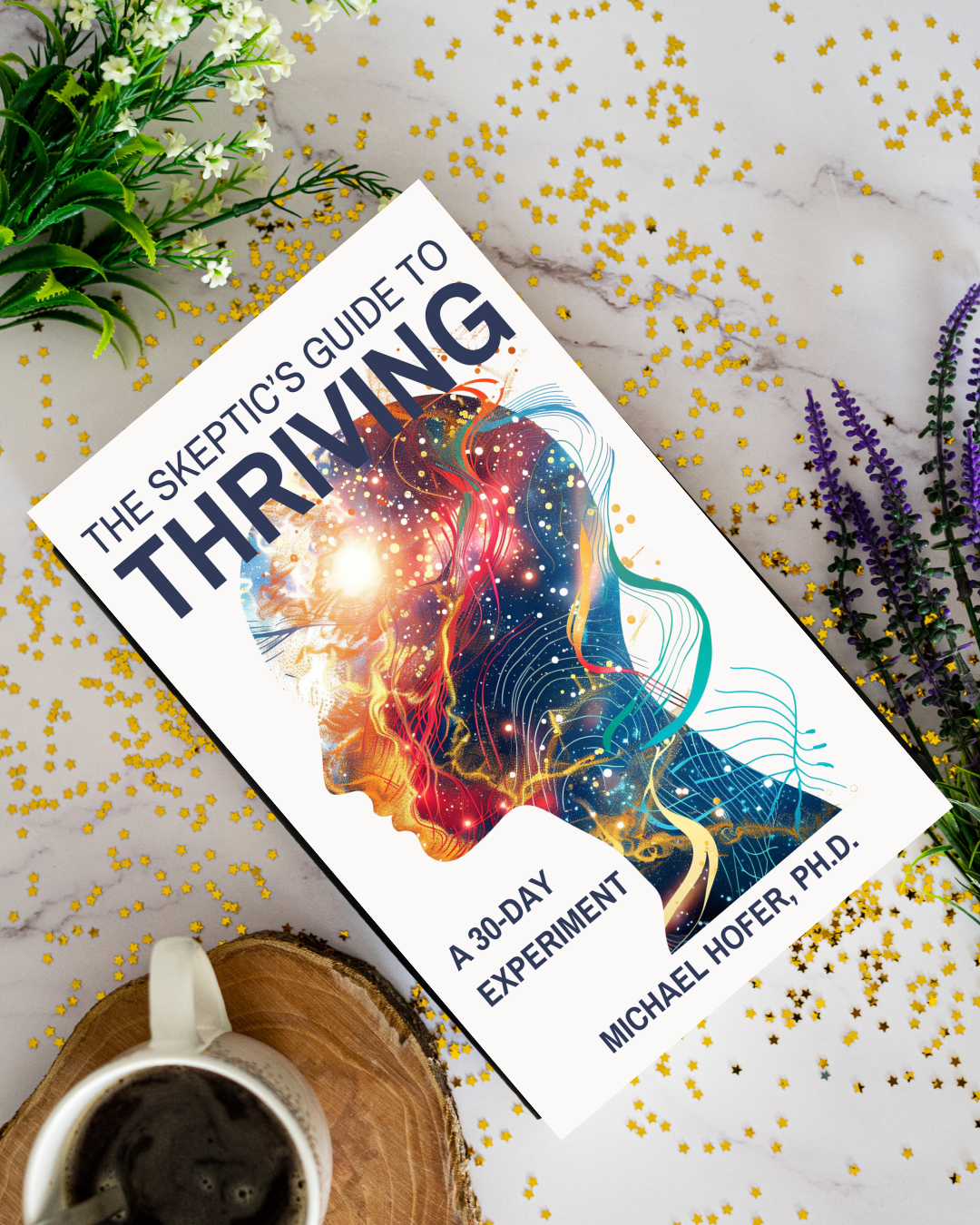
The Thrive framework gives you a structured path through this process — from defining the endpoint to rehearsing the vision to integrating it through daily choices to fully embodying the new reality. I'll go deeper into each step in future posts, and if you want the full protocol, The Skeptic's Guide to Thriving walks you through a 30-day experiment designed around exactly this.
But you don't need to wait for the full system. Start with the identity question. Everything else follows from there.