A Skeptic's Take on NLP: What's Useful, What's Not, and How It Fits the Thrive Framework
When people ask me about neuro-linguistic programming, I notice the same hesitation I once had about visualization itself. The promises sound enormous. The marketing borders on cultish. And the moment you start reading the claims — eye movements that reveal whether someone is lying, "magic words" that bypass resistance, weekend seminars that promise to rewire your nervous system — every analytical instinct says walk away.
I understand that instinct. It's the same one I had when I first heard about alpha states.
But the same discipline that made me eventually test the Silva Method and Dispenza protocols applies here, too. Look at the mechanism. Test what's testable. Keep what works. Discard the rest.
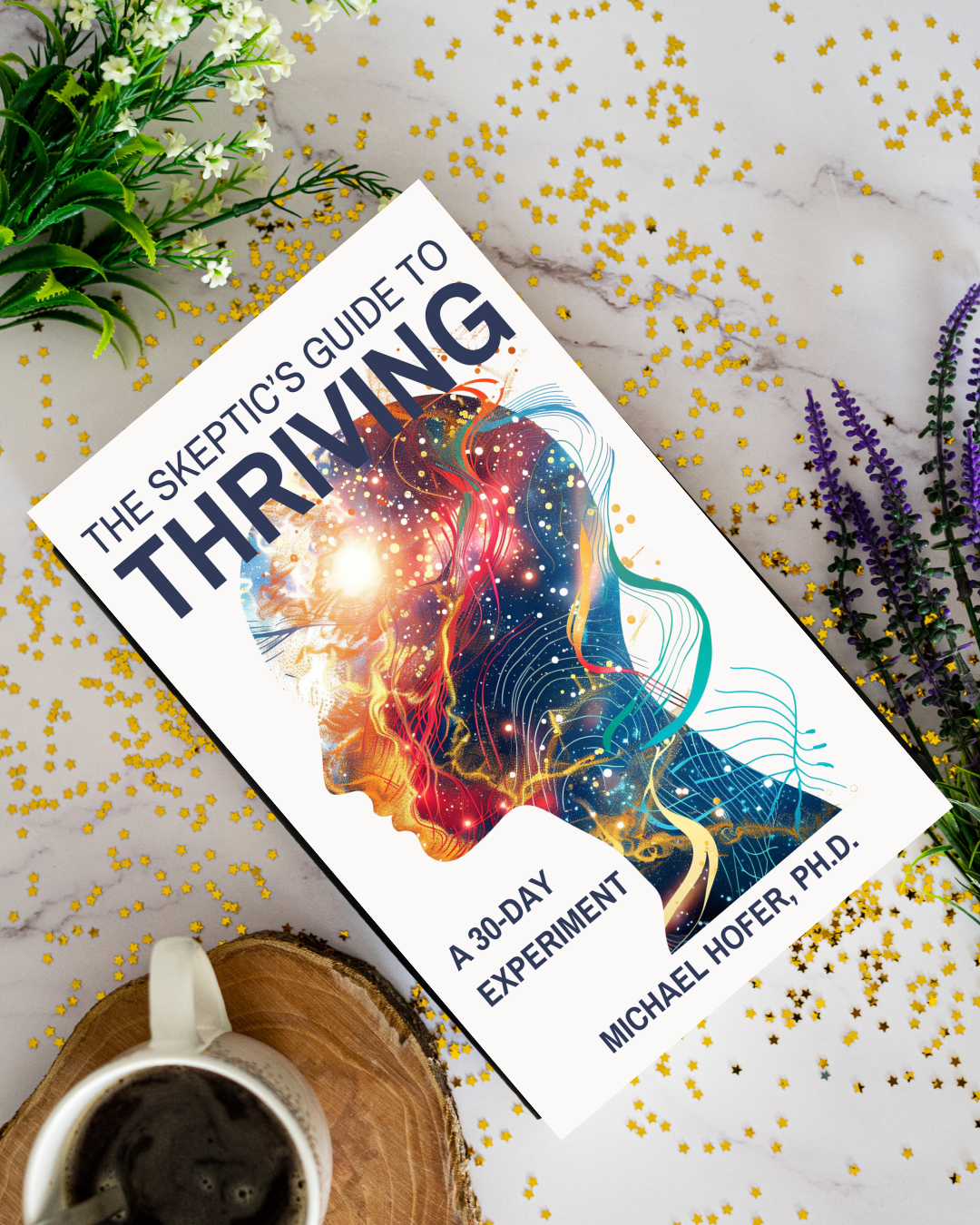
Here's an honest review of NLP from the same skeptical-executive perspective I bring to everything else on this site — and how the pieces worth keeping map onto the five-step framework I teach in The Skeptic's Guide to Thriving.
What NLP Actually Is
Neuro-linguistic programming was developed in the mid-1970s by Richard Bandler and John Grinder at UC Santa Cruz. Their idea was simple: study three therapists who were unusually effective at producing change — Fritz Perls, Virginia Satir, and Milton Erickson — and reverse-engineer their methods into transferable techniques.
The core premise is that subjective experience has structure. That structure shows up in language and behavior. Once you can detect the structure, you can change it.
NLP became enormously popular through the 1980s and 1990s, especially among coaches, salespeople, and seminar leaders. Tony Robbins — who I've written about as one of the pioneers behind my approach — built much of his early work on NLP foundations before evolving into his own synthesis.
The trouble is that NLP grew faster than its evidence base. By the time researchers got around to testing the specific claims, the practitioner community had already moved on to selling certifications. And when the studies came in, the results were unkind.
The Honest Empirical Picture
Let me give you the part most NLP marketing leaves out.
The signature claims unique to NLP — eye-accessing cues that reveal cognitive processes, preferred representational systems as a stable personality trait, the VAK learning-styles model, and "matching predicates" as a rapport mechanism — have largely failed to be replicated in controlled studies. Most academic psychology classifies NLP as pseudoscience, or at best as a set of unsupported practitioner heuristics.
If I'm being honest, that should give any skeptic pause. It certainly gave me pause.
But here is where it gets interesting. Several techniques that NLP packaged in the 1970s overlap substantially with practices that do have evidence, under different names, in different traditions. Cognitive reappraisal. Motivational interviewing. Sports-psychology visualization. Classical conditioning. Goal specification. Exposure-based work.
In other words, NLP is a practitioner's toolkit assembled before the mechanisms were properly understood. Some of what's inside survives translation into evidence-based language. Much of it doesn't.
That's the lens I want to apply here. Not "is NLP true?" — that's the wrong question. The right question is: which specific NLP techniques have a mechanism we can defend, and how do they slot into a framework that already works?
Mapping the Useful Pieces to the Thrive Framework
If you've read the book or followed my work, you know the five-step framework: Think From the End → Harmonize Your Energy → Rehearse the Vision → Integrate the Identity → Embody the Reality. Let me walk through where NLP techniques earn their place — and where they don't.
Step 1: Think From the End
NLP contributes something genuinely useful here: the well-formed outcome. It's a checklist for stating a goal in a way your brain can actually navigate toward. Stated positively (what you want, not what you don't). Sensory-specific evidence (what will you see, hear, and feel when you have it?). Self-initiated and self-maintained. Ecologically sound (it won't blow up other parts of your life).
This is the same discipline I push in the 30-day experiment. "I want to be healthier" is not a destination. "I check my glucose monitor and see 115 mg/dL while I feel calm in the dentist's chair" — that's a destination. The well-formed outcome framework is just a structured way to force that specificity, and it works for the same reason living in the end works: your brain navigates toward sensory targets, not abstractions.
What to take: the well-formed outcome checklist. What to leave: the mystical language that often surrounds it in NLP trainings.
Step 2: Harmonize Your Energy
This is where NLP gets thinner. Its main contribution to state management is anchoring — pairing a peak emotional state with a physical stimulus (a touch, a word, an image) so the stimulus can later re-trigger the state.
If that sounds familiar, it should. It's classical conditioning. Pavlov's dogs. And it's almost identical to José Silva's three-fingers technique that I describe in the book — touch your thumb, index, and middle fingers together during alpha, repeat the protocol, and eventually that finger position triggers the state.
NLP didn't invent this. Silva had it formalized before Bandler and Grinder. Athletes have been doing it for a century — Boris Becker with his tongue out before serving, Michael Phelps with his pre-race rituals. What NLP did was give it a name and a packaged training. That's fine. The mechanism is real and well-supported.
What to take: anchoring as a deliberate practice, with the understanding that you're doing classical conditioning. What to leave: the idea that anchoring is somehow unique to NLP.
Step 3: Rehearse the Vision
Two NLP tools earn a place here. The first is submodalities — the specific qualities of your internal images, sounds, and felt sensations. Brightness, size, distance, location, volume, tone. NLP claims that changing the submodalities of a mental image changes its emotional charge.
This one has decent empirical support, though not under that name. Cognitive neuroscience has shown that the vividness, perspective, and sensory detail of imagery materially affect its emotional and physiological impact. When I teach you to rehearse in vivid multisensory detail — see it, hear it, feel it — I'm using the same principle. NLP just gave it a more granular vocabulary.
The second is the swish pattern — replacing an automatic negative self-image with a desired self-image by manipulating submodalities. The evidence for the specific swish technique is weak, but the underlying idea (deliberately substituting a rehearsed self-image for a default one) overlaps with what we already do in alpha-state rehearsal.
What to take: the submodality vocabulary as a way to make your rehearsals more precise. What to leave: the more elaborate swish protocols, which add complexity without clear benefit over what you're already doing.
Step 4: Integrate the Identity
NLP's contribution here is reframing — both context reframing ("when would this behavior actually be useful?") and content reframing ("what else could this mean?"). Closely related is the six-step reframe and parts work, which assumes that internal conflicts can be addressed by treating different "parts" of yourself as having distinct positive intentions to be negotiated with.
The reframing techniques have solid evidence supporting them under the term cognitive reappraisal in academic psychology. It's one of the most well-validated emotion-regulation strategies we have. When you ask, “What would the version of me who already has this do right now?" — that's reframing. You're stepping out of your current identity and reappraising the situation from a different vantage point.
Perceptual positions — viewing a situation from your own perspective, the other person's perspective, and a detached observer's perspective — are similarly useful and well-supported under other names (perspective-taking, cognitive flexibility training).
What to take: reframing and perceptual positions as integration tools. What to leave: the more elaborate parts-negotiation protocols, which can be useful but get murky fast and overlap with better-supported approaches like Internal Family Systems.
Step 5: Embody the Reality
NLP's most useful contribution to embodiment is its emphasis on physiology — that posture, breathing, and movement directly shape state and behavior. This isn't unique to NLP either (Tony Robbins built an empire on it, and the underlying research goes back to William James), but NLP's practitioner training does a good job of making it operational.
When you've integrated the new identity, you don't have to think about being it. Your body knows. The posture, the breathing pattern, the pace of speech — these are the markers that the new identity has actually installed. NLP practitioners are trained to notice these signals in others. The more useful application is noticing them in yourself.
What to take: deliberate attention to physiology as both a cause and a signal of state. What to leave: the elaborate calibration claims about reading other people's internal states from external cues, which mostly haven't held up.
What I'd Recommend
If you're a skeptic looking at NLP from the outside, here's my honest take.
Don't pay for an NLP certification expecting to learn something fundamentally new. The techniques that work are available in better-validated traditions — cognitive behavioral therapy, motivational interviewing, sports psychology, the Silva Method, and the broader visualization literature. You can read three good books and have most of what NLP teaches at a fraction of the cost.
But don't dismiss the toolkit either. The well-formed outcome checklist, the anchoring protocol, the submodality vocabulary, and the reframing techniques are all worth knowing. They sharpen the work you're already doing in the five-step framework. They give you a more precise language for what's happening inside your rehearsals.
The pattern here is the one I keep coming back to in everything I write: mechanism over mysticism. NLP wrapped some real mechanisms in mystical packaging, oversold what it couldn't prove, and got justly criticized for it. But the mechanisms underneath — conditioning, reappraisal, vivid imagery, perspective-shifting, physiological state regulation — are real and worth practicing.
Use what works. Discard the rest. That's the experiment.