The Boy With the “Broken Brain”: What Jim Kwik Teaches Us About Rewiring Your Mind

I'll be honest with you: for most of my career, I assumed memory was fixed. Either you had a sharp mind, or you didn't. Either you were born with the ability to learn quickly, or you spent your life compensating for the fact that you weren't. That belief felt logical to me — until I came across Jim Kwik.
Jim Kwik is currently one of the world's foremost experts on brain performance, memory improvement, speed reading, and accelerated learning. He has coached executives at Google, Nike, and SpaceX. He has lectured at Harvard, Stanford, and Singularity University. He has trained Hollywood talent and advised CEOs. He is, by any measurable standard, a success story.
But the beginning of his story looked nothing like the end of it. And that gap — and how he crossed it — is exactly why I'm writing about him today.
"The Boy With the Broken Brain" — A Starting Point, Not a Sentence
At five years old, Jim Kwik suffered a traumatic brain injury. The result was a child who struggled with focus, memory, and reading — who fell behind in school and was quietly written off by the adults around him. His teacher famously referred to him as "the boy with the broken brain." He carried that label for years.
He found solace in comic books, particularly the X-Men — characters who were misunderstood, labeled as different, and yet discovered that what made them outliers also made them extraordinary. He searched, he said, for Professor Xavier's school for gifted minds because he genuinely believed something as it must exist. Not magic. Not wishful thinking. A place where people learned how to use their brains differently.
The turning point came in college, where Kwik — still struggling, still labeled — was on the verge of dropping out. Overworked, malnourished, and exhausted, he ended up in the hospital. During his recovery, a mentor — a friend's father — handed him a book and a challenge: learn how your brain actually works.
That moment changed the trajectory of his life. Not because of inspiration. Not because of positive thinking. But because of the mechanism. Jim Kwik went from being a struggling student to a world-class brain coach not through willpower, but through understanding — and then systematically applying — how the brain learns, stores, and retrieves information.
His conclusion, stated plainly: "There is no such thing as a good or bad brain. There is a trained brain and an untrained brain."
That is not a motivational slogan. That is a testable hypothesis — and one that his own life has spent three decades proving.
Why Jim Kwik Belongs in the Same Conversation as Dispenza, Monroe, and Robbins
In The Skeptic's Guide to Thriving, I spend considerable time on figures like Joe Dispenza, Robert Monroe, and Tony Robbins — not because they are famous, but because each of them discovered a repeatable, neuroscience-grounded mechanism for changing how the brain operates. Dispenza mapped the neurochemistry of belief and identity. Monroe found that binaural audio could reliably shift brainwave states. Robbins proved that state management and massive, aligned action could compress years of change into days.
Jim Kwik belongs in that same lineage — but his entry point is learning itself. Where Dispenza works with belief architecture, and Monroe works with consciousness states, Kwik works at the intersection of memory encoding, emotional state, and mental rehearsal. His core insight: the way you receive and process information is a trainable skill, not a fixed trait. And that insight has profound implications for anyone trying to change their performance, their habits, or their identity.
Visualization, in Kwik's framework, is not an affirmation exercise. It is a memory and encoding tool. When you visualize something — a name, a concept, a goal — you attach imagery to information, and imagery is the language the brain actually speaks. Thinking, Kwik argues, happens in pictures. The more vividly you can see something, the more durably it encodes.
Now apply that lens to your own goals — your vision of who you want to become. Suddenly, visualization is not wishful thinking. It is targeted mental rehearsal for an identity you are building.
How Jim Kwik's Journey Maps to the Five-Step Thrive Framework
The Five-Step Thrive Framework at the heart of my book is not a philosophy. It is a repeatable sequence rooted in how the brain actually changes. When I look at Jim Kwik's arc — from the boy with the broken brain to the world's foremost brain coach — I see every single step of that framework playing out in real time.
Step 1: Think From the End — Stop Chasing the Broken Brain. Start Rehearsing a Limitless One.
Jim Kwik did not improve his memory by trying to fix his deficits. He improved it by orienting toward a completely different identity: a person with a limitless mind. The mental shift preceded the behavioral change. He stopped asking "how do I compensate for my broken brain?" and started asking "what does a person with an extraordinary brain actually do?"
This is the essence of Step 1. You do not chase the goal from your current identity. You inhabit the end state first — and then the actions that follow become natural extensions of who you already are, rather than exhausting efforts to become someone you're not.
Step 2: Harmonize Your Energy — Emotional State Is Not a Soft Variable
Kwik is emphatic on this point: emotional state directly determines how well we learn, retain, and perform. He consistently teaches that accessing what he calls a "genius state" — a playful, curious, open mindset — is not a nice-to-have. It is the prerequisite for learning to stick.
In the Thrive Framework, Step 2 focuses on calming the nervous system so that new information and patterns can take root. A dysregulated, high-cortisol, fight-or-flight brain does not absorb new programming easily. It defaults to what it already knows. Kwik's genius state and the Thrive Framework's harmonized energy point to the same biological mechanism: the brain learns best when it feels safe enough to be open.
Step 3: Rehearse the Vision — Visualization Is the Brain's Native Language
This is where Kwik's work becomes especially instructive for Thrive practitioners. His memory system is built on a central premise: we remember what we can see. Abstract information — names, numbers, concepts — encodes weakly. Vivid imagery encodes strongly. The brain does not store words. It stores pictures.
This is not a metaphor. This is neuroscience. The visual cortex is among the brain's most powerful processing centers. When you attach a strong, emotionally resonant image to information — whether that information is someone's name or your own future identity — you are leveraging a biological advantage that has nothing to do with talent.
The 30-day visualization protocol at the center of the Thrive experiment works precisely because it uses this same mechanism. You are not hoping your brain will change. You are giving it a vivid, repeated, emotionally charged picture of who you are becoming — and training it, through repetition, to treat that image as real.
Step 4: Integrate the Identity — Decisions Follow Identity, Not Willpower
Kwik draws a direct line between identity and behavior: when you consciously decide to identify with a habit or goal, you experience a different quality of motivation. You are no longer pushing yourself toward something. You are expressing who you already believe you are.
He did not become a brain expert by forcing himself to study harder. He became one by gradually, genuinely coming to see himself as someone whose life's work was the human mind. The identity came first. The daily behaviors followed naturally — because they were consistent with who he was, not a constant act of discipline against who he had been.
This is Step 4 in practice. The internal shift — the integrated identity — becomes the source code for your external decisions.
Step 5: Embody the Reality — Reach, Rest, Repeat
Kwik's model for growth is elegantly simple: reach, rest, and repeat. You push to the edge of your current capability. You allow recovery. You return and push again. Over time, what was at the edge becomes the baseline. The brain adapts — not metaphorically, but neurologically. New circuits form. Old patterns weaken.
This is exactly what Step 5 of the Thrive Framework is designed to produce. You are not trying to will yourself to a new identity in a single dramatic moment. You are allowing aligned action to make the transformation automatic — through consistent repetition, in a state of openness, toward a vision that is clear and emotionally real to you.
What Skeptics Should Actually Take From Jim Kwik's Story
Jim Kwik is not selling belief. He never has been. His entire career has been an argument against passively accepting the brain you think you have, and a demonstration that systematic, evidence-based training produces measurable results — regardless of your starting point.
The boy who was labeled "broken" did not become unbroken by hoping. He studied the mechanism. He built a system. He applied it consistently, refined it relentlessly, and eventually created one of the most successful brain-training platforms in the world.
If you are analytical, achievement-oriented, and slightly allergic to the kind of personal growth content that asks you to believe first and verify never, Jim Kwik's work is for you. Not because it is inspirational. But because it is reproducible.
And when you combine his approach to mental rehearsal, state management, and identity-level change with the Five-Step Thrive Framework, you are not working with philosophy. You are working with the operating instructions for a brain that is ready for upgrade.
Ready to Run the Experiment?
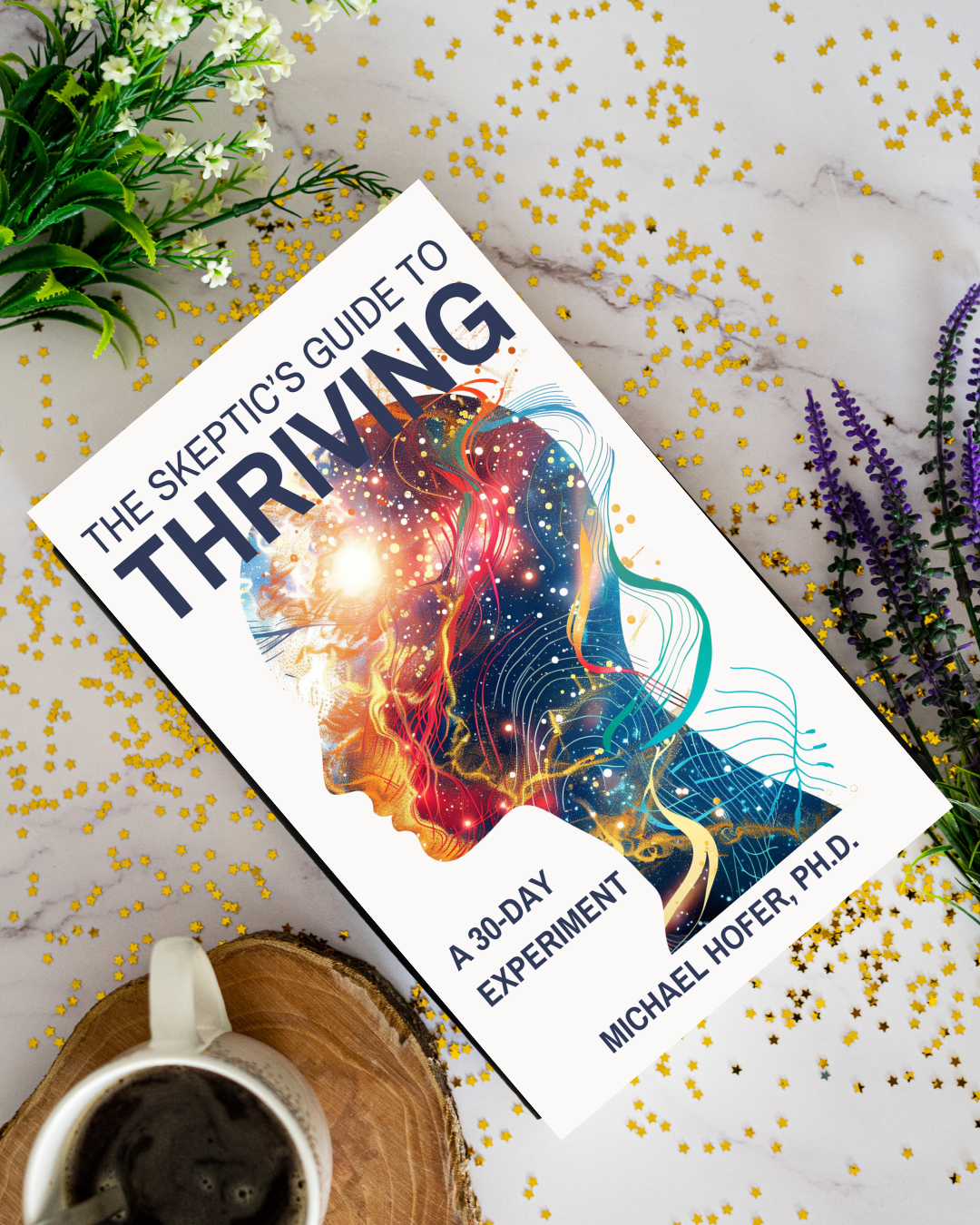
The Skeptic's Guide to Thriving is available now on Amazon. It is a 30-day experiment — not a promise, not a belief system. It is a structured protocol grounded in the same neuroscience that underpins Jim Kwik's work: that the brain is trainable, that visualization is a mechanism, and that aligned, consistent action compounds in ways that willpower alone never can.
You do not have to believe it will work. You just have to be curious enough to find out.