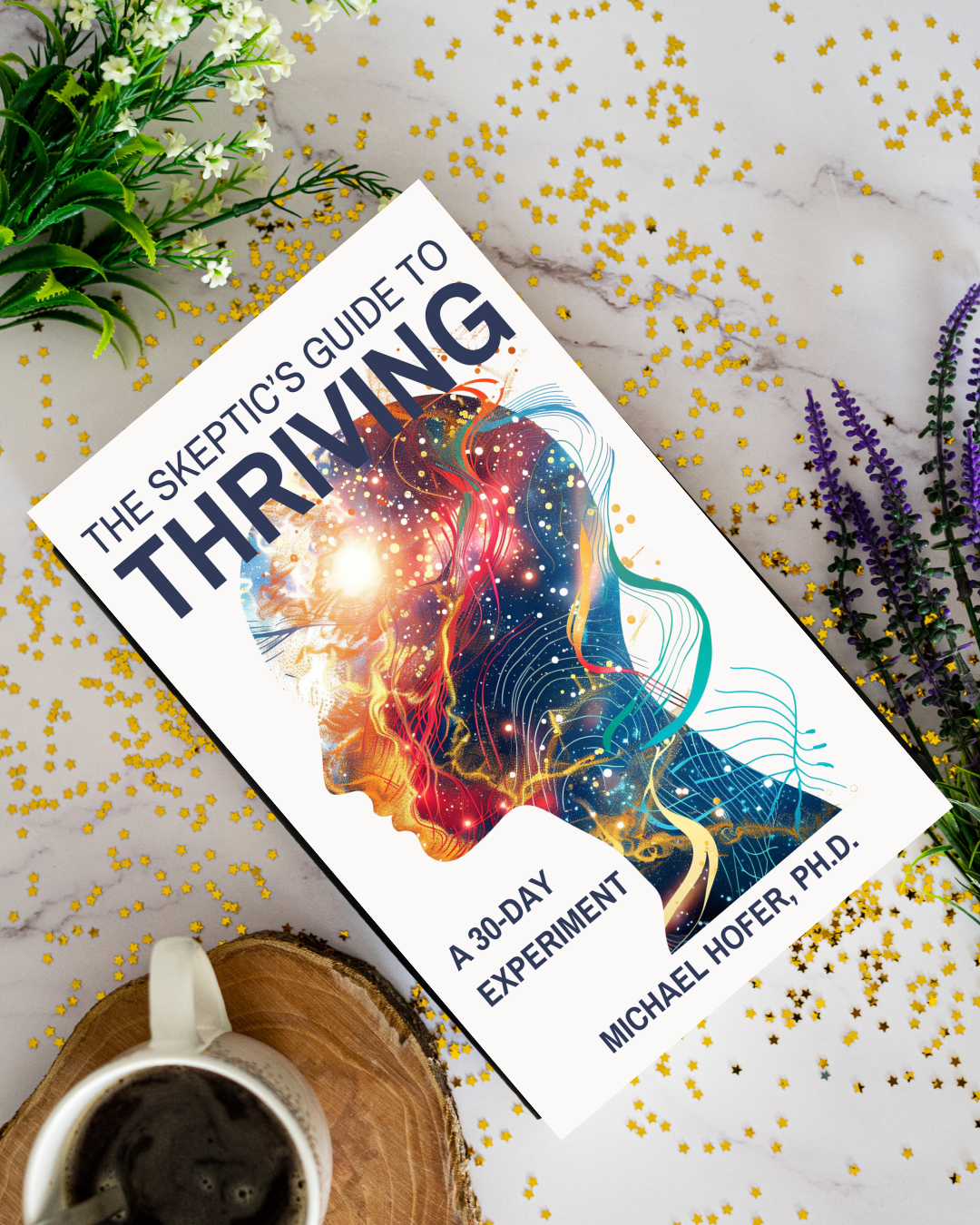
The Hidden Operating System Running Your Life

Right now, there is a program running in the background of your mind that is making the vast majority of your decisions.
It's not your goals. It's not your intentions. It's not the ambitious version of yourself who showed up at last year's strategy offsite with a fresh notebook and a plan.
It's your operating system — an invisible architecture of beliefs, expectations, and identity that was mostly installed before you turned seven years old, refined through decades of experience, and is now executing automatically, twenty-four hours a day, seven days a week.
And here's the uncomfortable part: most people who are trying to change their results are working furiously at the application layer while their OS quietly overrides everything they're trying to do.
What the Operating System Actually Is
When computer scientists talk about an operating system, they mean the foundational layer of code that manages all the hardware and software above it. It runs invisibly. You don't interact with it directly. But nothing works without it.
Your psychological operating system functions the same way. It consists of three interlocking components:
Your beliefs — the conclusions you've drawn about how the world works. Hard work pays off. People like me don't get that lucky. I'm not a natural athlete. Leaders are born, not made. You didn't consciously choose most of these. They were installed through repetition, experience, and the people who had authority over you when you were young.
Your expectations — the predictions your nervous system makes about what's coming. Your brain is a prediction machine. It constantly runs forward simulations based on pattern recognition from your past. If your history says "that kind of opportunity doesn't work out for me," your nervous system flags incoming opportunities with caution before your conscious mind even has a chance to evaluate them.
Your identity — the story you tell yourself about who you are. I'm a disciplined person. I'm someone who struggles with relationships. I'm not the type to take risks. Identity is the most powerful driver of behavior because it operates as a filter. We don't act randomly — we act in ways that are consistent with who we believe we are. Consciously or not.
These three elements — beliefs, expectations, and identity — form a closed loop. Your beliefs shape your expectations. Your expectations shape your behavior. Your behavior generates experiences that confirm your beliefs. The loop runs automatically, efficiently, and invisibly.
Psychologists call this confirmation bias. Neuroscientists call it predictive coding. I call it your OS — because the metaphor is accurate and because it suggests something important: operating systems can be updated.
Why Willpower Doesn't Work (And Why That's Not Your Fault)
When most people decide to change — to get healthier, perform better, think differently, show up as a different kind of leader — they reach for willpower. They set goals. They build accountability structures. They try harder.
And for a while, it works. The research on this is actually fairly encouraging: willpower is real, it functions like a muscle, and it can be strengthened.
But there's a problem. Willpower is a conscious process. It runs at the application layer.
Your OS runs deeper — and it runs continuously.
This is why the same patterns keep showing up in your life. Not because you're weak or undisciplined. Because you are doing exactly what any rational system does: executing your programming. Your subconscious mind is not trying to sabotage you. It is doing precisely what it was designed to do — protect you, conserve energy, and keep you in line with who it believes you are.
Research suggests that somewhere between 90 and 95 percent of our daily mental processing is subconscious. That is not a rounding error. That is almost everything. Your conscious goals represent perhaps five percent of your cognitive activity. The other 95% is your OS, running on autopilot.
When willpower and the OS conflict, the OS wins. Not always immediately — but eventually, consistently, and without drama. You simply drift back to your baseline, like a thermostat returning to its set temperature.
The question isn't how to strengthen your willpower further. The question is: how do you update the OS itself?
The Reticular Activating System: Your OS in Action
There's a small bundle of neurons in your brainstem called the reticular activating system, or RAS. Its job is to act as a filter — deciding which of the millions of pieces of incoming information per second actually reach your conscious awareness.
You've experienced this without knowing it. The moment you decide to buy a red car, suddenly red cars are everywhere. They were always there. Your RAS just wasn't flagging them.
This matters enormously for how your OS shapes your reality.
When your identity says I am someone who struggles, your RAS gets calibrated to notice struggle. When your expectation says this probably won't work out, your RAS prioritizes evidence that confirms that prediction. When your belief says there's never enough, your filter highlights scarcity and misses abundance.
You are not seeing reality objectively. You are seeing a reality filtered through your OS.
And here's the other side: when you update your identity to I am someone who finds solutions, the RAS recalibrates. When your expectation shifts to there is an opportunity here, you start noticing things you were previously blind to. This isn't magical thinking. It is the predictable, documented outcome of how your brain's filtering system works.
The world hasn't changed. What changed is what you're looking for — and therefore what you find.
What You Can't Change From the Outside
This is where most self-help falls short.
We are very good at temporarily changing behavior. We can use incentives, accountability, and environmental design to shift what we do for days, weeks, sometimes months. These tools are valuable and shouldn't be dismissed.
But behavior that isn't anchored in identity tends to erode. You can build the habit of running every morning, but if your identity still says I am not an athlete, the friction never quite goes away. The behavior requires maintenance. It never becomes effortless.
Real transformation — the kind that feels permanent, natural, and almost obvious in retrospect — happens when the identity shifts first.
When Michael Phelps visualized his races, he wasn't just rehearsing technique. He was installing a version of himself: the person who had already won, who already knew what that felt like in his body, who expected to compete at that level. By the time he stepped on the starting block, his OS had already processed the outcome. He wasn't trying to achieve something alien. He was executing something familiar.
When Oprah talks about her certainty — the feeling she had early in her life that she was meant for something significant — that wasn't arrogance. It was identity. Her OS was already running a different program than her circumstances suggested was reasonable.
Jim Carrey wrote himself a ten-million-dollar check, not as a party trick, but as a deliberate act of identity installation. He was telling his subconscious: this is who I am. This is what I expect. And then he showed up at comedy clubs every night and did the work that matched that identity.
These are not mystical stories. They are case studies in OS updating.
How You Actually Update the Operating System
Here's what I've found — through my own experience and through the body of research behind practices like the Silva Method, the work of Dr. Joe Dispenza, and the Monroe Institute's Hemi-Sync technology — that updating your OS requires accessing a specific brain state.
Your conscious, analytical, waking-state mind is excellent at many things. Updating the subconscious is not one of them. The analytical layer is, by design, resistant to new programming. It scrutinizes, evaluates, and filters incoming information. This is useful for critical thinking. It's an obstacle for identity change.
The alpha state — a relaxed yet highly focused state of awareness running at 8-13 Hz — is the access point where the subconscious becomes genuinely receptive. In alpha, the analytical mind softens. The guard comes down. New neural programs can be installed — not forced in through repetition and effort, but installed through vividly imagined experience.
When you rehearse a version of yourself in alpha — seeing clearly, feeling the emotions, inhabiting the identity of the person who has already arrived at your goal — your nervous system begins to process that experience as real. Neural pathways fire. Associations form. The RAS gets recalibrated toward that identity.
This is the foundation of the Thrive Framework: not a set of motivational reminders you tape to your mirror, but a systematic approach to accessing the brain states where real change becomes possible, and then anchoring a new identity through aligned action.
Because here's the other half of the equation, and it's non-negotiable: the updated OS still requires action to manifest results.
Visualization without execution is expensive daydreaming. The alpha state gives you the updated programming. Your daily choices — the small decisions, the habits, the conversations — are how that programming becomes real. When these two forces align, the change feels less like a struggle and more like momentum. You stop fighting yourself. You start executing toward what your OS now recognizes as home.
A Practical Invitation
Before you move on, consider this question honestly:
What identity am I actually running right now?
Not the identity you aspire to. Not the version you're working toward. The version your current behaviors reveal. The version that explains your patterns, not just your intentions.
Most people find a gap. That gap is not evidence of failure — it's the map. It tells you exactly what OS update is needed.
The Thrive approach begins there: not with better habits or stronger willpower, but with the recognition that you are running a program, and that programs — unlike character, unlike fate, unlike "the kind of person I just am" — can be rewritten.
Be a seeker, not a believer. Test it for yourself. Run the experiment.
Your autopilot can be set to run toward what you actually want. It just needs a new set of instructions.