The Acceleration Effect: How Thinking From the End Triggers Fast-Forward Moments

For 40 years, I tried to outwork my type 1 diabetes.
Not metaphorically. Literally. I tracked carbohydrates with the precision of a quarterly close. I read every research paper I could find on glycemic variability. I optimized my insulin pump like it was a P&L. And for four decades, my A1c hovered exactly where you'd expect from someone working very hard on the wrong problem—competent, never exceptional, perpetually one stressful week away from sliding.
The frustrating part wasn't the effort. The frustrating part was that the effort didn't compound. Each year, I knew more, did more, and tracked more. And each year, I was still grinding. The discipline was real. The results were a flatline.
Then something changed. Not because I added more willpower. Because I subtracted it.
The Switch I Almost Missed
About two years ago, I started experimenting with alpha-state visualization. (If you're new here, that's the relaxed brain frequency where the subconscious becomes receptive to new programming. It's not mystical—it's measurable on an EEG.) Every morning, I'd spend ten minutes vividly experiencing perfect blood sugar control. I'd see the glucose monitor reading 110. I'd feel the steady, calm energy of a stable day. I rehearsed it in detail.
For some time, nothing changed.
I almost quit. I came very close to writing the whole thing off as the expensive daydreaming I'd always suspected it was. Then I noticed what I was actually doing wrong.
I was thinking about the goal—the way most goal-setters do. I was holding the future in front of me like a target. And as long as I held it out there, my brain treated it as a destination I had to get to through effort. The visualization was happening; the identity wasn't shifting. I was still the diabetic-trying-to-get-better, not the person whose blood sugar was already steady.
So I changed one thing. Instead of visualizing the journey to stable blood sugar, I started living from a moment that could only exist if it were already true. A morning where I checked my CGM out of curiosity, not anxiety. A dinner where I stopped eating because I was satisfied, not because I was tracking. A workout I did because I was fit, not because I was trying to become one.
I stopped thinking about the end. I started thinking from it.
That's when things started to accelerate.
What Happened Next Was Strange
(And It Shouldn't Have Been)
Within a few weeks, I started noticing something I couldn't explain at the time. Choices that used to require negotiation with myself no longer did. At breakfast, I'd reach for the lower-carb option without an internal debate—not because I was disciplining myself, but because the other option simply didn't appeal. At dinner, I'd put the fork down when I was satisfied, sometimes before I consciously registered I was full. When stress hit, I'd find myself doing 4-7-8 breathing without remembering when I started.
Stranger still: ideas about my management started arriving unsolicited. In the shower. On a walk. Between meetings. I'd suddenly know I needed to adjust my basal rate two hours earlier, or that my pre-workout snack was wrong for the morning, or that the Wednesday spike I'd been chasing for months was actually a sleep issue. I hadn't been consciously working on any of these problems. The answers just showed up.
By month 18, my A1c was 5.5. After 40 years of type 1 diabetes. Most endocrinologists would call that exceptional. I'd call it strange—except I now understand exactly why it happened.
Why Thinking From the End Creates Fast-Forward Moments
Here's the mechanism. No mysticism, just neuroscience.
Your brain has a filter called the reticular activating system—your RAS. It decides which information from your environment reaches your conscious awareness and which is discarded. You can't pay attention to everything, so your RAS pre-sorts reality based on what your subconscious has tagged as important. If your subconscious has tagged "I am a stressed diabetic struggling with control" as your identity, your RAS highlights every scary number, every spike, every reason to worry. You walk past the calm, stable moments because they don't match the pattern.
But when you spend time in the alpha state experiencing yourself as someone whose blood sugar is already steady, you start reprogramming what the RAS filters for. Your subconscious begins tagging that identity as the operating reality. And from that moment, your brain starts highlighting different information. The healthier choice becomes more visible. The stressful trigger becomes less salient. The right adjustment to your routine becomes obvious.
This is what neuroscience now calls functional equivalence—the brain's inability to distinguish between a vividly imagined experience and an actual experience when you're in the right state. The mystic Neville Goddard described this in the 1940s, decades before fMRI existed to measure it. He called it "living in the end." His instruction was specific: don't visualize the journey to your goal. Construct a brief scene that could only exist if the goal were already real. Then live from that moment.
When you do this consistently, two things start happening in the background:
Your RAS begins filtering reality differently. Opportunities that were always there but invisible suddenly appear. The connection that walks into the room. The article that lands in your inbox the same week you needed it. The conversation that opens an unexpected door. These aren't coincidences. They're confirmation bias working for you instead of against you, because you've reprogrammed what counts as evidence.
Your subconscious works on the problem while you don't. While you sleep, drive, exercise, or stand in line for coffee, your autopilot is processing—connecting dots, rehearsing scenarios, scanning for paths. When the answer "arrives" in the shower, it didn't arrive randomly. It was delivered. Your conscious mind got the credit; your subconscious did the work.
This is what I mean by fast-forward moments. The acceleration isn't cosmic. It's computational. You're running a process in parallel that you used to try to run sequentially through willpower alone.
Jim Carrey didn't manifest a $10 million check by sitting on Mulholland Drive. He spent years there reprogramming his RAS to filter Hollywood for opportunities his "broke and unknown" identity had been walking past. The directors weren't summoned. They were noticed. Then he showed up, night after night, at every comedy club that would have him. The acceleration happened because two systems were finally working together: a subconscious filtering for the right doors, and a conscious executor walking through every one of them.
The acceleration always looks like luck from the outside. From the inside, it's the predictable result of running both systems at once.
The One Caveat That Separates This From Manifestation
When the opportunity surfaces, you still have to act on it. The fast-forward moment is your brain delivering the path. If you don't walk it, nothing accelerates. As Carrey told Oprah, you can't visualize and then go eat a sandwich.
I want to be honest about this because it's where most "manifestation" content fails. Visualization without aligned action is daydreaming. Action without visualization is grinding through willpower. The acceleration only happens when both are running. The blueprint and the construction crew. The autopilot and the pilot.
For me, that meant when my subconscious started delivering "small choices"—the lower-carb breakfast, the unbroken workout streak, the breathwork at the right moment—I had to take those actions. Not white-knuckle them. Just take them. The decisions felt natural because the identity had shifted. But they still had to be made.
Run the 30-Day Experiment
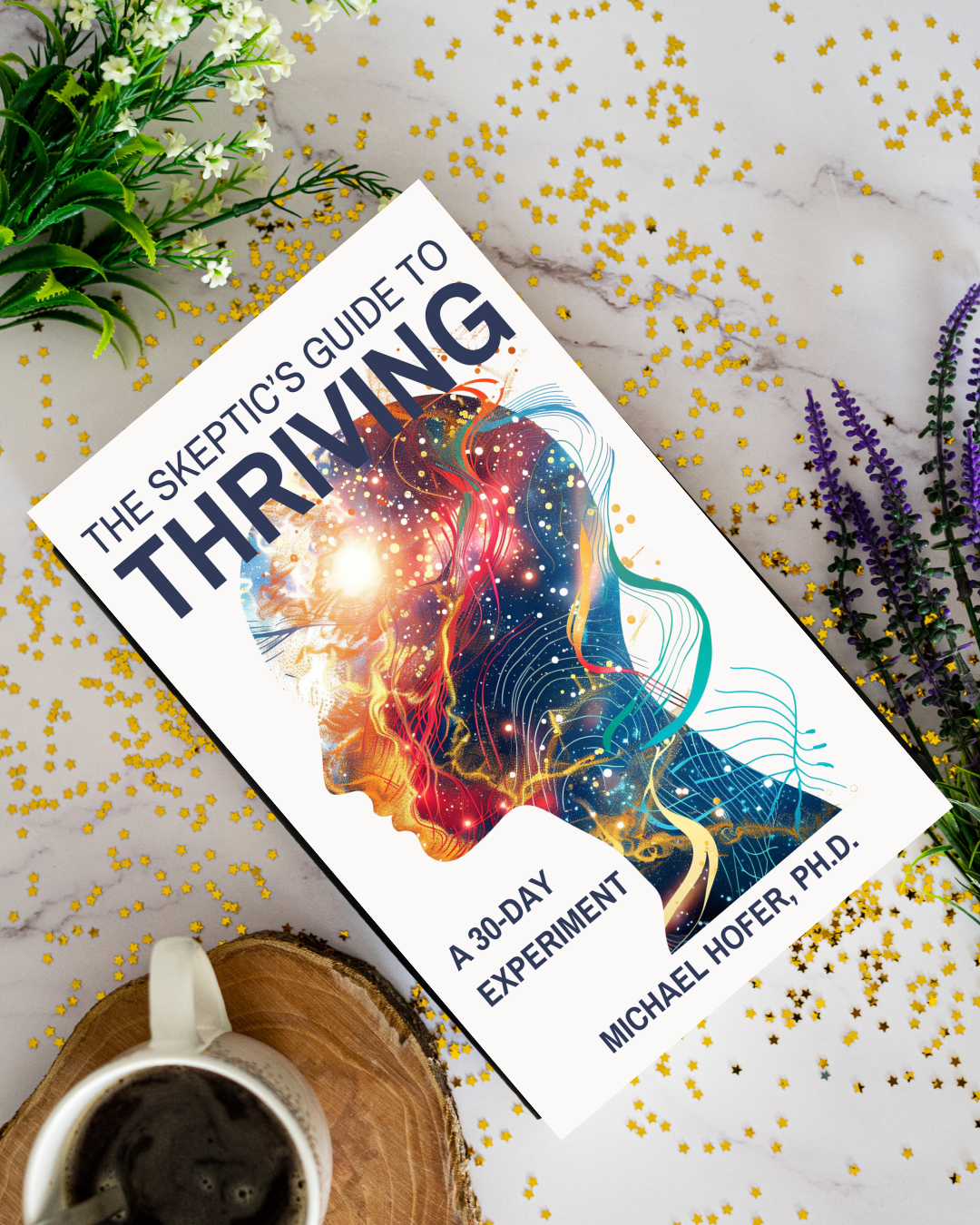
If this sounds like something worth testing—and I'd argue, as a CFO, that any system promising compounding returns deserves at least 30 days of due diligence—I've laid out the full protocol in The Skeptic's Guide to Thriving. The book walks you through the complete five-step framework, the daily practice, and an honest assessment framework you'll use on Day 30 to evaluate whether the mechanism produced measurable results in your life. Not mine. Not anyone else's. Yours.
You'll spend ten to fifteen minutes a day in the alpha state, rehearsing a vivid scene that could only exist if your chosen outcome were already real. You'll ask the integration question—What would the version of me who already has this do right now?—and act on the answer. And you'll track what shows up: the unsolicited ideas, the noticed opportunities, the choices that suddenly feel obvious.
On Day 30, you'll have data. Not faith. Data.
That's how I started. Ten minutes a day. Not because I believed in it, but because I wanted to see what would happen. What I discovered was that thinking from the end isn't a goal-setting technique. It's a way of recruiting your own subconscious as a co-conspirator—and once you do, the path to the future you've been chasing starts arriving in pieces you didn't have to plan.
The mechanism is real. The acceleration is real. The question is whether you'll run the experiment.
I'd recommend you do. And enjoy it.