Where Focus Goes, Energy Flows: The Neuroscience Behind Tony Robbins' RPM Method

"Where focus goes, energy flows."
If you've spent any time in the personal development world, you've heard Tony Robbins say this. Probably multiple times. Maybe even shouted it while jumping up and down at a stadium event you swore you'd never attend but somehow found yourself at anyway. I did it at home during an online UPW (Unleash the Power Within) event with Tony Robbins two years ago, and I rediscovered it with his Time of Your Life program on his app in 2026.
Here's what I've learned after decades of being that skeptical CFO in the back row: when something gets repeated that often, it's either complete nonsense... or there's a mechanism underneath that actually works.
Turns out, it's the latter.
The Problem With Motivational Slogans (And Why This One's Different)
Most motivational phrases are empty calories. They sound good in the moment, maybe get you fired up for a Tuesday morning, then fade by lunch when your inbox explodes and reality reasserts itself.
"Where focus goes, energy flows" sticks around because it's more than just a motivational slogan. It's neuroscience wrapped in four words.
And if you understand the mechanism, you can use it deliberately rather than hoping for inspiration. Let’s dig deeper.
What RPM Actually Does (Beyond Making Lists)
Tony Robbins' Rapid Planning Method isn't really about planning. It's about training your brain's attentional filtering system—specifically, your reticular activating system (RAS).
Your RAS is essentially the bouncer at the nightclub of your conscious awareness. Every second, your brain processes millions of data points from your environment. The RAS decides what gets through the velvet rope and what stays outside in the chaos.
Here's the interesting part: your RAS filters based on what you've told it matters, and you can change the filter. That’s called neuroplasticity in the brain.
When you repeatedly focus on problems, your RAS highlights problems. You'll spot risks everywhere, notice limitations constantly, and collect evidence that everything's harder than it should be.
When you repeatedly focus on outcomes and opportunities, your RAS begins to surface resources, connections, and opportunities you previously walked past.
This isn't positive thinking. This is how your attentional system actually operates.
The Critical Distinction: Occasional vs. Sustained Focus
Here's where most people get it wrong (and why most goal-setting fails by February):
Occasional focus creates inspiration.
Sustained focus creates identity shift and behavioral momentum.
This is what I got wrong during the UPW event: It was a great push, but I didn’t continue and changed my autopilot, my subconscious. The RPM focus on the Time of Your Life program changed that. Also, my Thrive Framework helped me to discover the importance of using alpha-state visualizations to reach the subconscious.
You can get fired up at a seminar, write down your goals, feel amazing for three days, then watch it all evaporate when you hit the first obstacle.
Or you can understand that the real work is training your RAS through continuous, emotionally charged repetition until your brain automatically starts filtering your world differently.
That's when things get interesting.
RPM's Three Questions (And Why They Sound Familiar)
Robbins structures RPM around three core questions:
What result am I committed to creating?
Why does it matter deeply?
Who must I become to achieve it?
If you've read my book or spent any time with the Thrive Framework, you're probably experiencing déjà vu right now.
Because those three questions map almost perfectly onto three of the five steps:
Steps 1 and 2: Think From the End = "What result am I committed to creating?"
You don't start with tasks. You start with the outcome. Specific, clear, emotionally resonant. This isn't vague hoping—it's precise targeting that gives your RAS something concrete to filter for.
Step 3: Rehearse the Vision = The sustained, emotionally charged repetition
This is where the magic happens. Not once. Not when you feel inspired. Continuously. You're literally rewiring your attentional filters through repeated exposure to the outcome, charged with the emotions of already having achieved it.
When you rehearse consistently, your RAS stops treating your vision as fantasy and starts treating it as expected reality. It begins scanning your environment for matches.
Steps 4 and 5: Integrate the Identity = "Who must I become to achieve it?"
This is the shift from "I want to do this" to "I am the kind of person who does this." When your identity changes, your automatic behaviors change. You're not forcing discipline anymore—you're simply acting consistent with who you are.
Why This Matters for Skeptical Executives
I spent years dismissing all meditations, visualizations, and similar practices as "woo-woo" nonsense. Vision boards? Manifestation? Come on.
Then I started testing the mechanisms.
Not because I believed. Because I was curious whether there was something underneath the mysticism that actually worked.
Turns out, there is.
Your RAS doesn't care whether you believe in the law of attraction. It just filters based on sustained patterns of focus. Give it clarity, repetition, and emotional charge, and it does its job. And then you have to combine it with massive actions.
RPM works for the same reason the Silva Method works. For the same reason, Dr. Joe Dispenza's rehearsal protocols work. For the same reason, elite athletes visualize performance.
Because they are all training the same attentional filtering system through slightly different pathways.
The Experiment I'd Suggest
If you're skeptical (and you should be), try this for 30 days:
First, write down one result you're committed to creating in 30 days. Make it worthwhile, because you will think about it and work on it for a whole month.
Then, every morning, spend 10 minutes in RPM mode:
First, relax to become receptive to new ideas. If you want, you can use the Silva method. Read about it here.
Remember what you want to achieve.
Focus on why it matters—not surface reasons, deep emotional reasons. Feel them.
Visualize the outcome as if it's already done, feeling the emotions.
That’s it in the morning. 10 minutes are sufficient.
During the day, ask yourself one question a few times: What would the version of me who already has this do right now? Then, do it. In Tony’s words: Take massive action.
Then watch what you notice.
Not what you force. What you notice.
New connections appearing. Resources surfacing. Conversations that "randomly" address exactly what you need. Opportunities you would have walked past last month.
That's not the universe conspiring. That's your RAS doing exactly what you trained it to do.
Mechanism Over Mysticism, Always
It doesn’t matter if you frame this as Tony Robbins' RPM, the Thrive Framework, or just "smart planning backed by neuroscience."
What matters is understanding the mechanism: sustained, emotionally charged focus rewires your attentional filters and changes what you see, what you pursue, and ultimately what you achieve. Then, take massive actions every day.
You don't have to believe it works.
You just have to test whether it does.
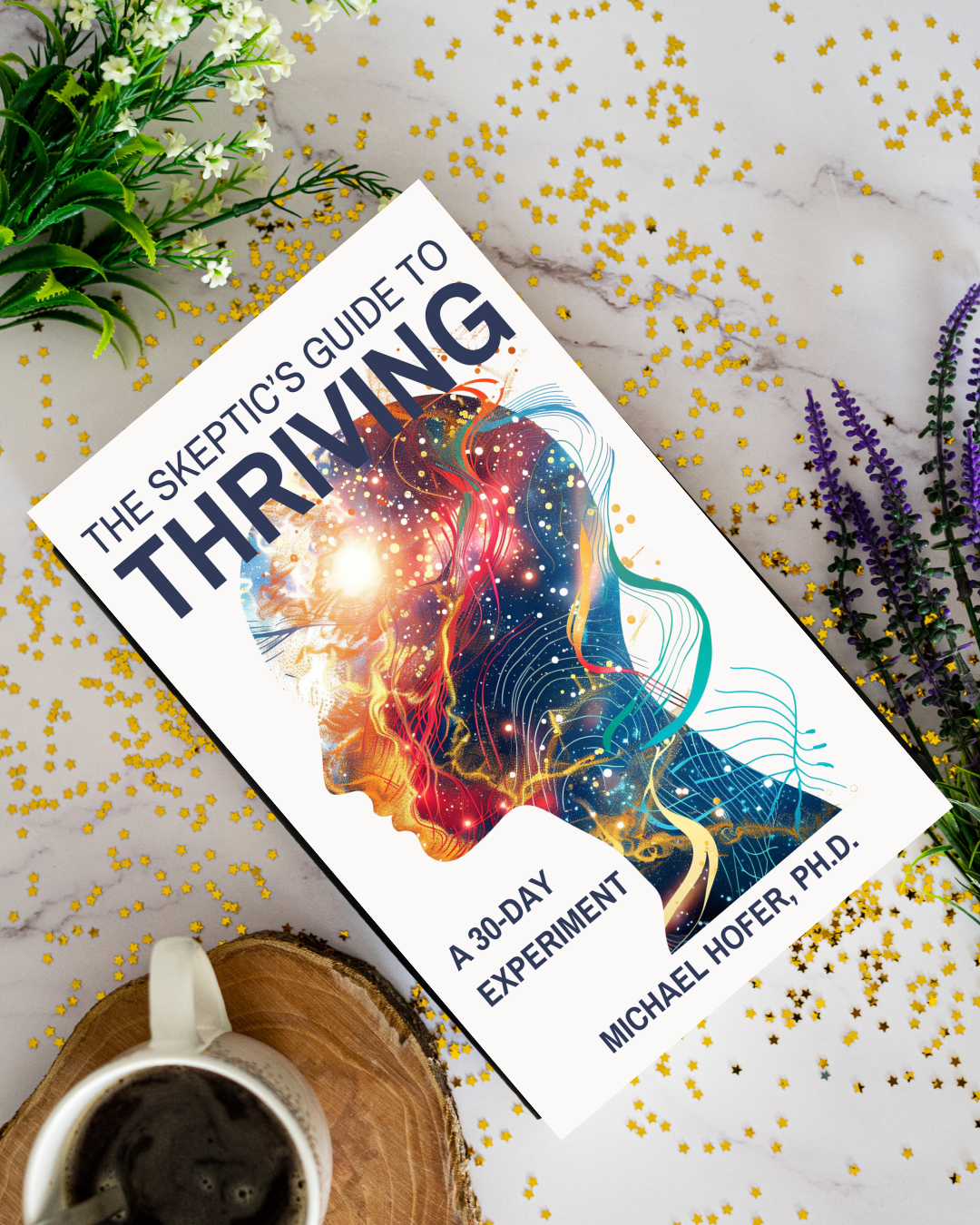
Ready to experiment? Download the full Five-Step Thrive Framework in my book, The Skeptic's Guide to Thriving: A 30-Day Experiment. No mysticism required—just mechanisms that work.